
There is a moment in every economic crisis when a central bank governor looks into the camera and admits, with carefully chosen words, that the tools at their disposal are no longer sufficient. That the levers they've spent careers learning to pull - interest rates, forward guidance, quantitative easing - cannot solve the problem at hand.
Wednesday was that moment for Canada.

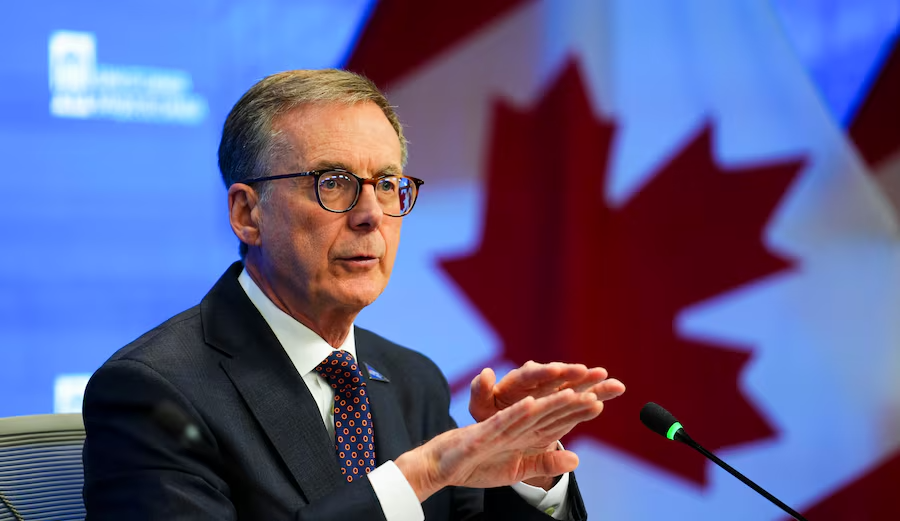
Bank of Canada Governor Tiff Macklem lowered interest rates to 2.25 percent, but cautioned that monetary policy can't fix the structural economic damage caused by the U.S. trade war. The rate cut - a 25-basis-point reduction for the second consecutive meeting - was expected. What came next was not.
"For many months, we have been stressing that monetary policy cannot undo the damage caused by tariffs," Macklem said during a news conference in Ottawa. While monetary policy can help the economy adjust to these circumstances, "it cannot restore the economy to its pre-tariff path," he explained.
Translation: We've done what we can. The rest is beyond our control. And the economy you knew? It's not coming back.
This is what surrender looks like in central banking - not dramatic, not theatrical, but measured, technical, and devastating in its implications. Because when a central bank admits it cannot solve the problem, it's acknowledging that the problem is no longer economic. It's political. And politics, as Canada is learning the hard way, doesn't respond to interest rate adjustments.
The Numbers Behind the Surrender
The Bank of Canada cut its benchmark overnight rate by 25 basis points on Wednesday, bringing the policy rate to 2.25 percent, the lowest since July 2022. Officials stated that if inflation and economic activity evolve broadly in line with their October projection, they see the current policy rate at "about the right level" to keep inflation close to two percent while helping the economy through this period of structural adjustment.
Read between the lines: This is the last cut. Maybe.
The Bank signaled that if the outlook changes, "we are prepared to respond," but the current rate now sits at the bottom of the central bank's estimated neutral range of 2.25 to 3.25 percent - the level that neither stimulates nor restricts economic activity.
Going lower would mean moving into outright stimulus territory, cutting rates below what's considered economically neutral. And the Bank is clearly reluctant to do that, for reasons that reveal just how boxed in Canadian policymakers have become.
"We expect cutting beyond that (2.25 percent), into outright stimulative levels of interest rates, will be more difficult with inflation still sticky at an above-target rate and fiscal policy potentially ramping up as a support after the federal budget in early November," said Abbey Xu, economist at RBC .
The trap is elegant in its simplicity: Canada needs lower rates to stimulate growth, but inflation is still above target at 2.4 percent. Cut too aggressively, and you risk reigniting price pressures. Hold steady, and the economy stagnates. There is no good option. Only bad and worse.
The Damage That Can't Be Repaired
Tariffs imposed by the U.S. on steel, aluminum, and automobiles have hurt Canada's exports, leading to a 1.6 percent economic contraction in the second quarter . That's not a slowdown. That's a recession-level decline.