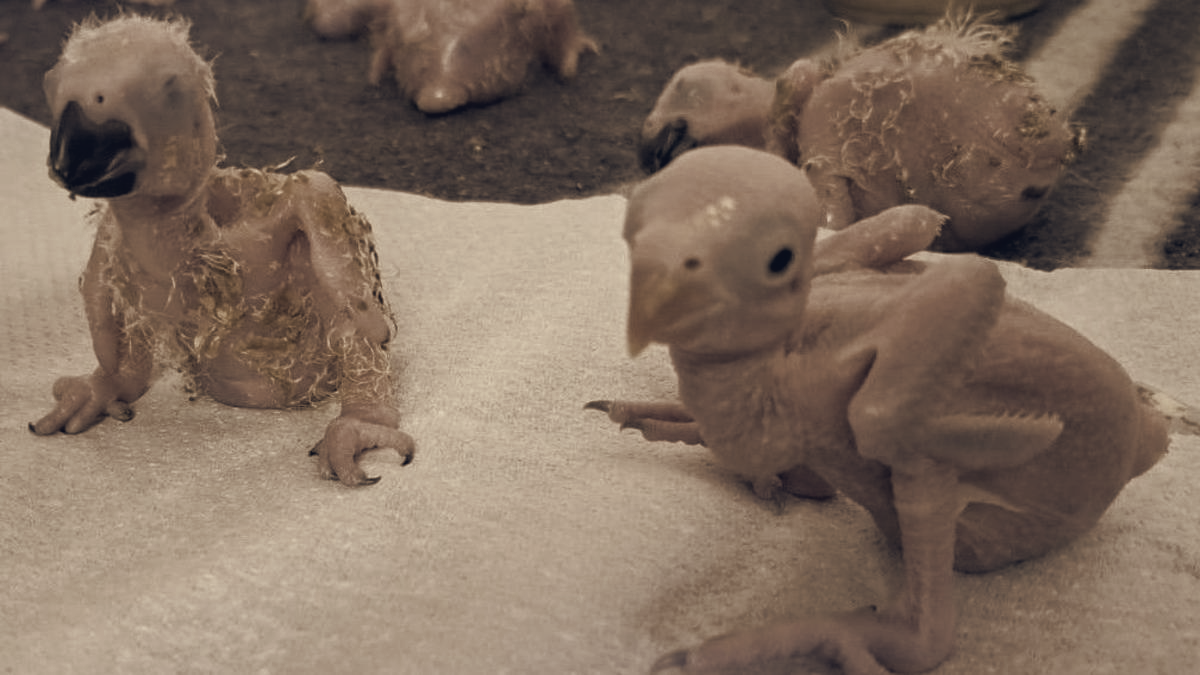

Rescued parrot chicks are now receiving intensive care after officials intercepted Fifty suspected parrot eggs at Johannesburg's OR Tambo International Airport and arrested a 50-year-old Thai national last Thursday.
Staff at the National Zoological Garden in Pretoria have taken responsibility for the eggs and the hatchlings, providing round-the-clock care to try to preserve the birds. The Department of Forestry, Fisheries and the Environment, DFFE, said many of the seized eggs have successfully hatched and that the chicks are in "intensive" care to "maximise their chances of survival". Initial investigations indicate the eggs belong to a parrot species listed under the Convention on International Trade in Endangered Species of Wild Fauna and Flora, CITES.
Authorities detained the suspect after a joint operation involving the DFFE, the Green Scorpions, and several police divisions. If convicted, the individual faces a fine of up to 10m rand ($626,000, £461,000) or up to 10 years in prison, or both. The DFFE described the interception as part of wider work to disrupt criminal networks that package eggs in improvised incubators and move them abroad in conditions that endanger embryos and hatchlings.
Environment Minister David Maynier praised the coordinated response, saying "illegal wildlife trafficking can only be challenged by a co-ordinated defence of our natural heritage". He also thanked the zoo staff, saying they are "who have been working tirelessly to incubate the seized eggs and provide specialised care to the hatchlings". The department noted that a previous arrest in July involved a 23-year-old Thai citizen caught at OR Tambo with 418 parrot eggs, underscoring the scale and persistence of the trade.
South Africa remains a frequent target for wildlife traffickers, who also trade in elephants and pangolins on the international black market. To counter the threat, the government adopted a strategy six years ago to strengthen collaboration among government bodies, law enforcement, conservation authorities, customs officials, prosecutors and international partners. Investigations into the latest seizure will continue while prosecutors decide whether to bring formal charges, and conservation teams will focus on nursing the hatchlings through the critical early weeks.