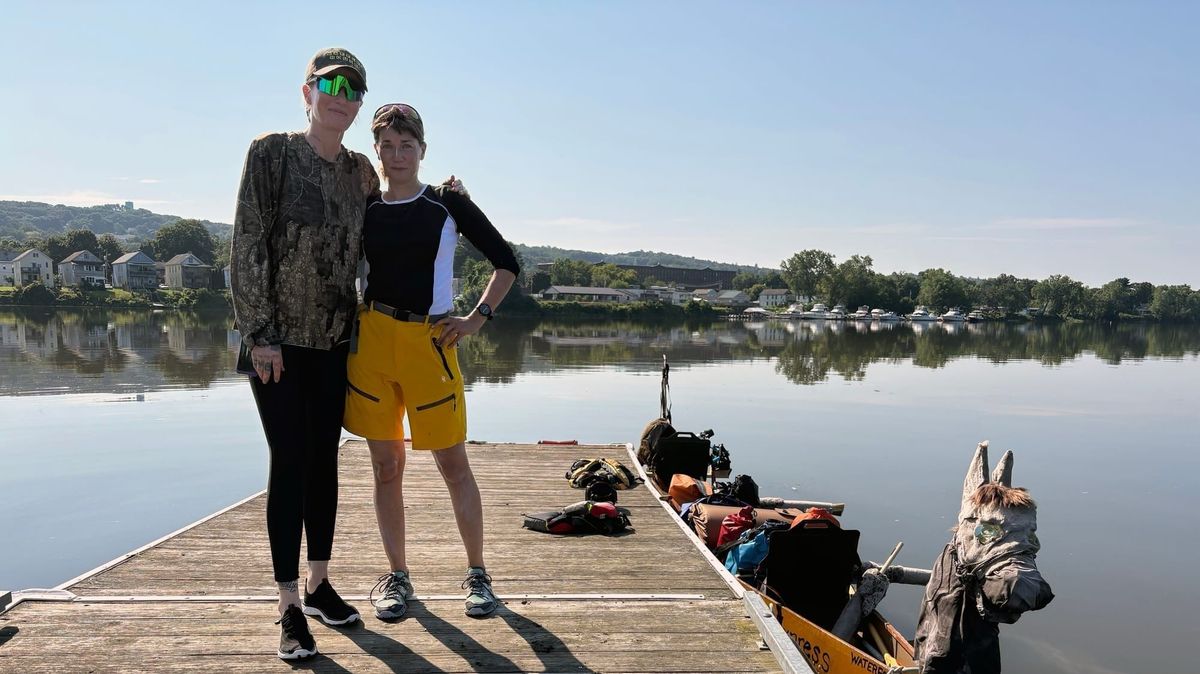

What happens next: Z Behl and Kim Moloney are scheduled to finish a five-week, 350-mile canoe passage to Buffalo on Friday, September 5. The pair, working as BALONEY STEEL under the title Mule's Passage, launched in early August from Waterford, New York, and have been paddling roughly six hours a day while camping along the canal.
Their departure was a small public ritual. Elders sang on a dock beneath faded American flags, supporters gathered, and playwright Judy Tate, founder of the American Slavery Project, delivered a spoken-word piece. Behl and Moloney slipped their mule-decorated canoe into the Eastern Gate corridor, the first lock system that raises craft from the Hudson and Mohawk into the canal, and moved upriver against a hot summer current as the singers continued from the bridge above.
Mule's Passage frames the body as both engine and storyteller, an artistic and anthropological restaging of the towpath labor that shaped the United States' economy. The trip follows old towpaths across counties that sit on six territories of the Haudenosaunee Confederacy, and the artists use the journey to name the waterway's role in Indigenous displacement, the disruption of land stewardship, and the breaking of contracts with Native communities.
Along the route the duo records interviews with ecologists, historians, activists, and residents to surface ecological stresses caused by the manmade canal and to gather local memories and work songs. Their canoe relies on a small electric outboard with solar charging supplied by Bixpy, and Camp Chow provided dehydrated meals for the trek. The project has support from the Erie Canal Museum Artist-in-Residence program and the New York State Canal Corporation, among other partners.
Documentation from Mule's Passage will travel beyond the waterway. The Everson Museum of Art in Syracuse plans a spring 2027 exhibition of the project's archive and findings. For now the expedition moves county by county, transforming a performative act of paddling into a sustained conversation about labor, landscape, and whose histories the canal has long left off the map.