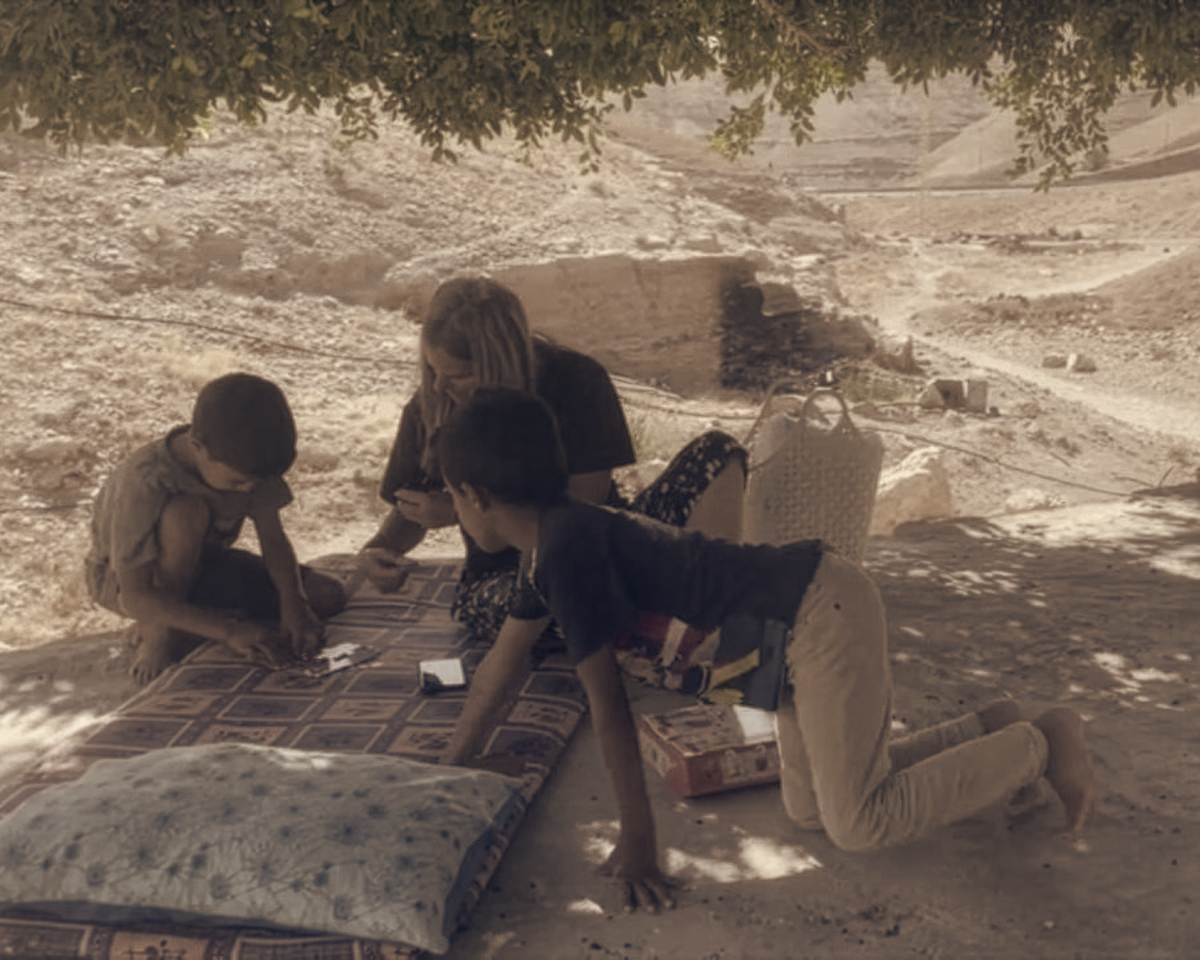

The continued existence of Khan al-Ahmar’s makeshift “school of tires” now hinges on international pressure, the veteran Israeli director Amos Gitai says. The school, off Highway 1 between Jerusalem and Jericho, serves around 300 Bedouin children, has been denied an Israeli building permit, and has operated for eight years under the threat of demolition.
Gitai brought that fragile site to the Venice film festival in The Road to Jericho, a largely elliptical documentary that treats recent history as a tidal churn. The 75-year-old director threads a portrait of the school through four decades of footage, including material from his own archive. The film also doubles as a self-examination, with Gitai probing his role as observer and chronicler of the occupied West Bank. The critic Michael Atkinson once called him "Israel’s one-man New Wave," a label that helps explain why his cinema combines intimacy with a long view.
The Road to Jericho stitches together past and present, at times inserting archival clips of public figures from the era of the Oslo accords. Gitai traces a trajectory from that false dawn to the present collapse of dialogue, arguing that the assassination of Yitzhak Rabin removed a political actor prepared to bargain and compromise. "Everything has been destabilised and we are now in the hands of people who don’t want peace," he says, adding that many Israelis have spent the last three years "in a state of shock at the levels of violence and savagery we are seeing."
Gitai describes his films as civic gestures. "I consider my work as a civic gesture," he says, and he rejects didactic filmmaking. He first encountered Khan al-Ahmar while shooting another project a decade ago and felt compelled to use film to defend the school. He is sceptical that art can directly change political outcomes, but insists that cinema can "scratch a memory," and that ideas matter alongside force and money.
The Road to Jericho screens amid a cluster of Middle East, focussed entries at Venice, where documentaries and immersive works are putting Palestinian dispossession at the centre of festival conversation. Gitai invokes earlier work, including Field Diary, his 1982 film from Gaza, and recalls advice he recorded from Palestinian figures: Bassam Shakaa once said, "Pessimism is a luxury we cannot afford." Gitai stops short of optimism, but points to Europe’s post‑war reconstruction as proof that recovery after catastrophe is possible, and argues that hope and ideas remain central motors for change.
The film does not promise immediate policy shifts, but it aims to keep Khan al-Ahmar’s story in international view. Its fate remains uncertain, and Gitai hopes the act of witnessing will help preserve memory and sharpen pressure on the authorities whose decisions will decide whether the school endures.