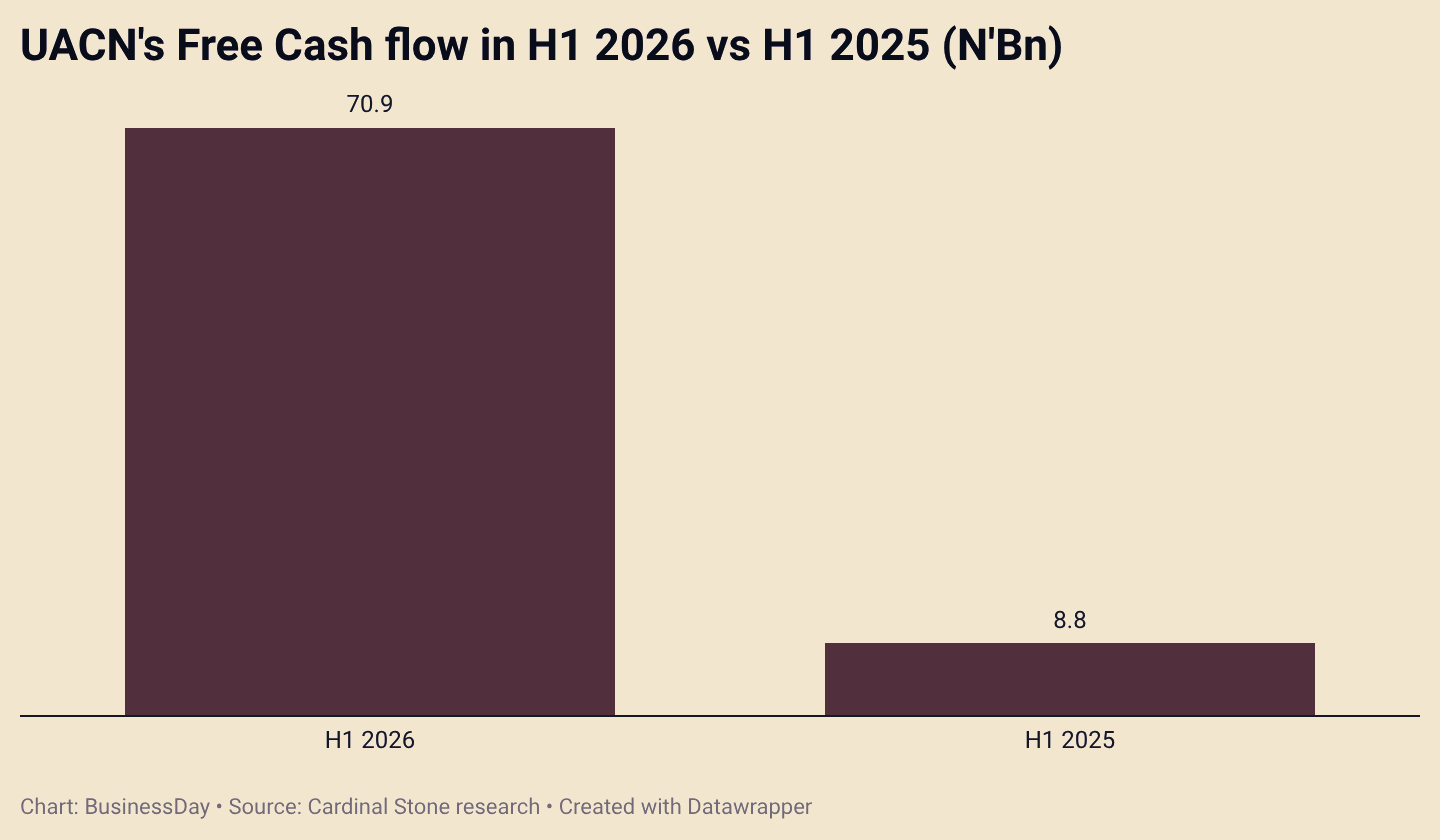

CardinalStone Research said UACN produced ₦70.9 billion in free cash flow in H1 2026, a sharp rise from ₦8.8 billion in the same period last year, helped by better operating performance and lower inventory levels.
The improved cash profile cut group debt from ₦344.8 billion at the end of 2025 to ₦307 billion in H1 2026, and persuaded CardinalStone to trim its FY2026 total debt forecast to ₦284 billion from ₦297 billion previously. The firm said continued deleveraging should bolster the company's balance sheet.
Lower borrowing costs reflected the repayment: financing costs declined by 18.8 percent quarter on quarter in Q2 2026, according to CardinalStone.
UACN’s Packaged Foods and Beverages division drove the group’s top line in H1 2026, accounting for 84.2 percent of revenue. CardinalStone pointed to the consolidation of C.H.I. Limited as a key contributor, noting the integration is delivering quicker-than-expected benefits. C.H.I.’s operating margin widened to about 15.1 percent in H1 2026 from roughly 2.2 percent at acquisition, following gains in procurement, energy optimisation, packaging, route-to-market and pricing.
The research house also highlighted falling costs for several raw materials, including granulated sugar, laminate, whole milk powder and vegetable oil, which could further support margins. CardinalStone expects volume growth to stay supportive in the second half, especially around the festive season, while easing inflation and relative naira stability may moderate input costs.
CardinalStone cautioned that energy costs remain a principal downside risk amid geopolitical uncertainty and fuel price volatility, but retained expectations of ongoing efficiency gains and further benefits from the C.H.I. integration. The firm raised its 12‑month target price for UACN to ₦246.65 from ₦241.18, an implied upside of 38.6 percent from its reference price of ₦177.90, and maintained a BUY recommendation.
What happens next will hinge on continued free cash flow to drive further debt reduction toward the revised forecast and on the company’s ability to contain energy-related input costs as the year progresses.