
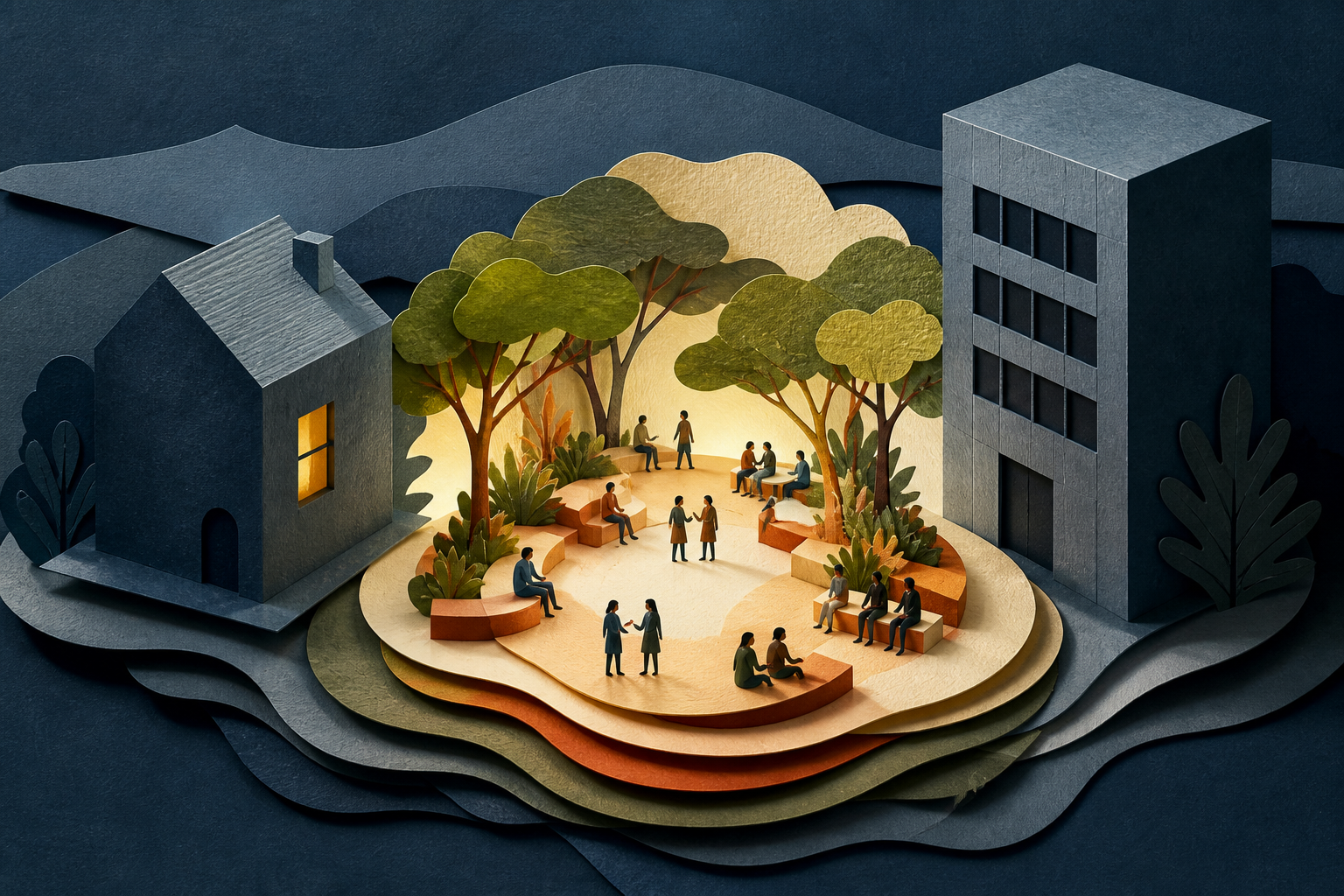
The places where people spend time without a formal invitation are easy to overlook. A library, park, café, sports club, market or community centre can appear ordinary until it is absent. Yet these settings often provide the low-pressure contact that makes a neighbourhood feel inhabited rather than merely occupied.
They are places where people can sit, walk, read, wait, play, buy something, exercise or simply spend time near others. They do not require the shared obligations of a workplace, the privacy of a home or the commitment of a formal group. For many people, that is precisely their value.
The idea of the “third place” describes this space between home and work. It is not one specific type of venue, and it is not limited to commercial settings. It can be public, community-run or informal. What matters is that it creates an opportunity for people to be around one another without every interaction needing to be arranged in advance.
That distinction has become more important as concern about loneliness and social isolation grows. The World Health Organization’s Commission on Social Connection has identified both as widespread challenges with consequences for health and well-being. Its 2025 report points to the value of place-based approaches and includes accounts of people who describe parks, libraries and other third spaces as settings that make connection more possible.
The significance of these spaces is often found in small, repeat encounters. A familiar face at a local market, a conversation after a sports session, a regular visit to a library or time spent in a park can create a sense of recognition. Such contact may not immediately become friendship, but it can make everyday life feel less anonymous.
This does not mean every café, park or shared venue automatically solves social isolation. A space can be open in theory while remaining difficult to use in practice. It may be too expensive, too far away, inaccessible, poorly maintained or designed for people to move through quickly rather than stay. Commercial spaces can also depend on spending, which limits who can use them comfortably.
Nor should the social life of a neighbourhood be reduced to a property-development slogan. The term can be used too loosely, particularly when it is attached to new developments without asking whether people can genuinely access, afford or remain in the spaces being promoted.
The more useful question is practical: where can people be present with one another without needing to belong to the same workplace, household or private group?
That question matters in cities shaped by remote work, long commutes, small homes and a more fragmented social rhythm. When work is less tied to a shared office, and when time is divided by travel, caregiving or financial pressure, unplanned contact can become harder to find. The spaces between home and work may then carry more of the social function that workplaces, streets and neighbourhood routines once provided.
This gives ordinary urban features greater importance. Public seating, shade, reliable transport, accessible parks and well-supported libraries are not decorative extras when they make it easier for people to stay, return and participate. A bench, a route that feels reachable or a public building that welcomes people to spend time can affect whether a place becomes part of daily life.
The same is true of community centres, sports clubs and markets. Their role is not only defined by the service they provide. They can also create a setting in which people encounter others outside their existing circles. That may be especially important for people whose work, housing or family arrangements leave little room for informal social life.
The return of the third place as a planning idea reflects this basic point: social connection needs room. It depends not only on individual effort, but also on whether cities and communities make ordinary presence possible.
The places that work best may not look dramatic. They may be the spaces people use repeatedly because they are nearby, affordable, welcoming and easy to enter. But their cumulative effect can be significant. They make it easier for people to move from proximity to recognition, and from recognition to participation.