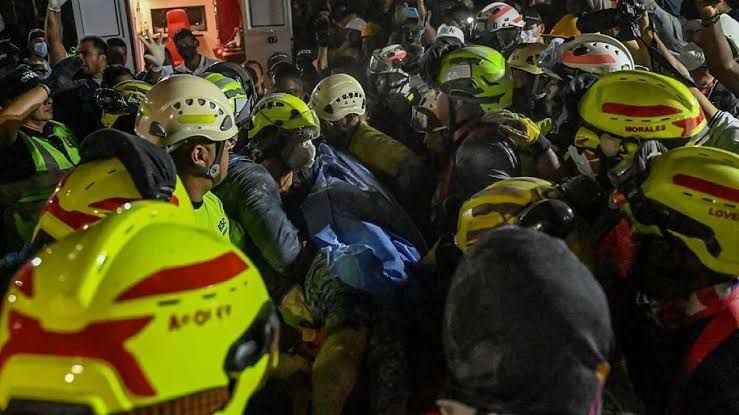
At least 188 people have died in the quake that shook western Colombia, with hundreds remaining missing, as a 32-year-old woman, Daniela Largo, was rescued alive from beneath the rubble in the city of Pereira. Largo was pulled from a collapsed building after a 10-hour rescue operation, during which firefighters dug a tunnel below four concrete slabs to reach her. The rescue was complicated by the heavy concrete slabs blocking the way, but with the aid of a small camera, emergency workers were able to locate Largo and provide her with oxygen through one opening, before freeing her through a second tunnel dug from below.
In Pereira, a city in Colombia's coffee-growing region, 79 people are confirmed to have died, the second-highest number after Cali, where 95 are dead, according to figures by the Association of Colombian Capital Cities. Largo's mother reported that a local resident had heard her daughter cry out for help from beneath the rubble, leading emergency workers to the site. Colombian President Abelardo de la Espriella celebrated Largo's rescue on social media, describing it as "news which fills us with hope", while Largo's mother noted that her 12-year-old son is waiting for her at home.
The 7.4-magnitude quake struck at 07:34 local time on Monday, with its epicentre near the village of San José del Palmar, in Chocó province, and could be felt across a vast area. In Cali, Colombia's third most populous city, more than 200 people remained trapped as of 16:00 local time on Tuesday, with the city's mayor declaring a night-time curfew and deploying soldiers to patrol the worst-hit areas. Rescue efforts continue, with the mayor stating that there is still hope of finding more people alive, and everyone will do their utmost to free those trapped.
In Pereira, at least 92 buildings collapsed, with 15 people known to be trapped and another 37 reported missing, according to the Association of Colombian Capital Cities. The rescue operation is ongoing, with local firefighters aided by colleagues from the capital, Bogotá, and the disaster response team of the national police force working to reach those trapped. As the situation continues to unfold, the Colombian government and emergency services remain focused on rescue efforts, with the hope of finding more survivors amidst the devastation.