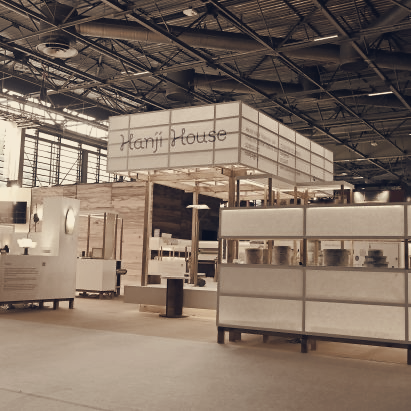
Designers and buyers at Maison&Objet will encounter hanji presented not as a museum artefact but as a working material for contemporary furniture, lighting and interior fittings. Curated by the Korea Craft & Design Foundation, Hanji House combines demonstrations and product displays intended to show how a paper made from the inner bark fibres of the paper mulberry tree performs in modern applications.
The exhibition emphasises hanji’s technical traits: dense, durable sheets produced by traditional papermakers that remain breathable, moderate humidity and offer faint translucency and a pronounced surface texture. Those qualities have long suited screens, window treatments and flooring, and the show maps how they translate to conservation materials, lamps, furnishings and lifestyle goods.
Seven Korean companies are exhibiting under the Hanji House banner: Hanji Park Materials Lab, Fides International Co., Toolpress, Somidang, Marquage G, Curated Columns and Pulbat. Korean industrial design studio SWNA will present four pieces that pair hanji with rigid components such as metal and stone, including a partition that doubles as lighting and a cabinet combined with curved lighting forms, intended to demonstrate the paper’s adaptability in spatial design.
"Hanji House is conceived as a showroom where visitors can experience Hanji's soft diffusion of light and responsiveness to airflow," the Korea Craft & Design Foundation said. The presentation includes both traditional handmade hanji and specialist conservation papers alongside crafted objects, stationery, fragrance products and lamps, so visitors can compare heritage techniques with new design translations.
The exhibition runs in the Signature gallery of Hall 7 at Paris-Nord Villepinte from 10 to 14 September as part of Maison&Objet 2026. The Korea Craft & Design Foundation frames the timing as significant: the event marks the 140th anniversary of Korea-France diplomatic relations and takes place before a UNESCO decision on inscribing hanji-related knowledge and practices on the Representative List of the Intangible Cultural Heritage of Humanity.
KCDF president Kyungbae Kim said the foundation’s goal for the show is twofold, "We hope to share the beauty and contemporary potential of Hanji with the world and create greater opportunities for businesses rooted in Korean traditional culture to expand internationally." The exhibition gives international buyers a concentrated opportunity to assess hanji’s practical uses and, if adopted, to open routes for Korean makers into new markets.