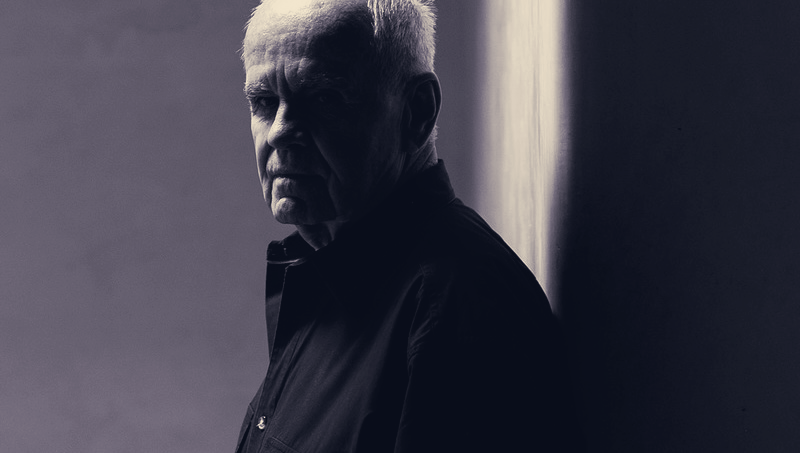

Readers gain unusually intimate access to Cormac McCarthy through Beowulf Sheehan's portrait session at the Santa Fe Institute and at the author's home. Sheehan arrived with his assistant Chika and set up in the institute library, where McCarthy appeared early and immediately broke the formal distance by chatting with the kitchen staff and greeting the photographers with a beaming "pleased to meet you." Sheehan notes the contrast in stature, McCarthy at perhaps 5'6" and the photographer at 6'2", but the warmth of the handshake made the stronger impression.
Sheehan worked the available light, noticing daylight spilling through a side window and asking McCarthy to use it. McCarthy agreed, and the session moved through corners of the library and onto a balcony that opened to the sky. Their exchange was spare and plain, but revealing. Asked why he comes to the institute he replied, "My friends are here. We love the same things. We argue." When pressed about science and Santa Fe he offered, "It's fun," and "It's home." Sheehan used those answers to position McCarthy within the places that matter to him, and to compose portraits that register both ease and attention.
At a long exterior adobe wall the writer asked, "Do you know the story of my typewriter?" He told Sheehan and Chika he had donated an Olivetti Lettera 32 to a Santa Fe Institute benefit; it fetched $250,000. A friend then bought a new one on eBay for a few dollars, a detail that left McCarthy smiling with quiet pride.
McCarthy then invited the photographers to his house. They followed his weathered truck through the city and out into open landscape until a two-story, perhaps 4,000-square-foot adobe home rose into view. Vehicles lay under tarps across a dusty driveway and lot. Outside, Sheehan asked about the cars. Pointing to one, McCarthy said, "That's a Corvette Stingray. I drove it back after I partied with Johnny Carson in Fort Lauderdale," and laughed to himself. The anecdote landed the subject in a domestic, lived-in setting rather than in literary mythology.
Sheehan packed equipment while McCarthy drifted back to his friends, and then photographed him among the house and cars he collects. The session moves from institutional light to private rooms and yards, and in the process reframes McCarthy not as an austere icon but as a man who loves place, companionship and small, telling stories.
These portraits and the moments around them preserve those details: the handshake, the balcony view, the typewriter's auction price, and a Corvette driven home from a party. They also mark what comes next for the images, a record of access born from an invitation to make more pictures at the writer's own home.