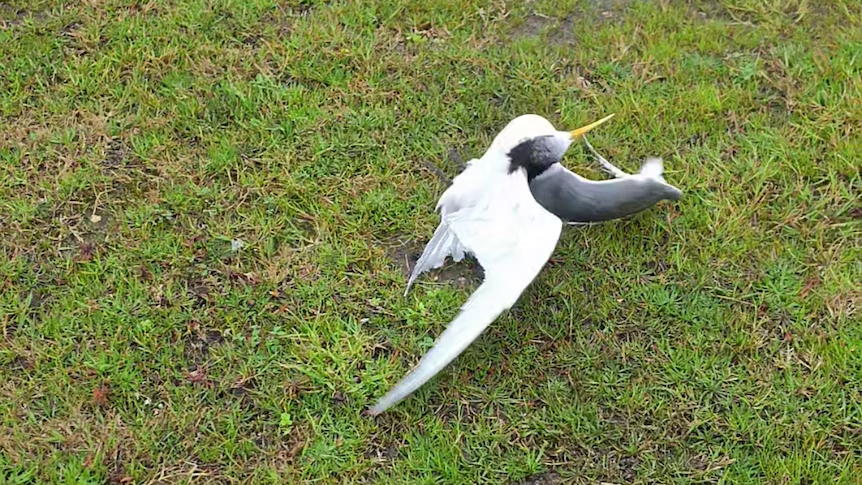

South Australian wildlife has suffered its largest detected seabird die-off since H5 arrived on the mainland, after aerial patrols located more than 1,000 dead greater crested terns across three offshore island sites. Premier Peter Malinauskas called the situation a "significant escalation" after the events were spotted on Troubridge Island off the Yorke Peninsula and on the Pages Islands, North Page and South Page, off Kangaroo Island.
State authorities have presumed the deaths are caused by H5 bird flu and are investigating a suspected case in a little penguin on Kangaroo Island, a development the premier told parliament was of "particular concern". The Islands are important breeding grounds, including for little penguins, black cormorants and colonies that attract visiting long-nosed fur seals and endangered Australian sea lions, increasing the conservation stakes.
Malinauskas said aerial surveillance on Wednesday used helicopters, planes and drones supported by field crews, and patrols were checking for affected mammals as well as birds. "Fortunately, so far, no mass mortality event … involving mammals has yet been detected or reported," he said, and officials reported no detections so far in poultry or livestock.
The government later confirmed additional detections of greater crested terns at Flagstaff Hill, McLaren Vale, North Haven in the Adelaide area, Lucky Bay on the Eyre Peninsula and Tanunda in the Barossa region. South Australia also recorded its first confirmed raven case at Port MacDonnell on the Limestone Coast. Georgie Cornish, executive director of biosecurity at the Department of Primary Industries and Regions, said the finding in the Barossa showed the "movement [of H5 bird flu] from [the] coast inwards".
Across the region, the Tasmanian government reported aerial surveillance spotted 28 dead little penguins and three dead crested terns at the Port of Grassy on King Island, with samples sent for laboratory testing and results expected during the week. New South Wales confirmed H5 in seven birds found at Narooma and Merimbula, six greater crested terns and a giant petrel, and said it was progressing plans to vaccinate priority captive native species.
South Australia said it is preparing targeted vaccination plans for priority captive species in collaboration with Zoos SA and Cleland wildlife park, considering captive little penguins, orange-bellied parrots, red-tailed black cockatoos, cape barren geese and pelicans. The state is also exploring options to vaccinate at-risk mammals such as Australian sea lions at Seal Bay on Kangaroo Island. Officials noted there are no registered vaccines for treating H5 in mammals, though the United States has run experimental trials on a small number of seals.
Officials said they will continue intensive surveillance and targeted interventions, while laboratory testing and field monitoring proceed across affected islands and coastal zones. The scale and inland spread of detections make containment and conservation planning the immediate priorities for state and inter-state authorities.