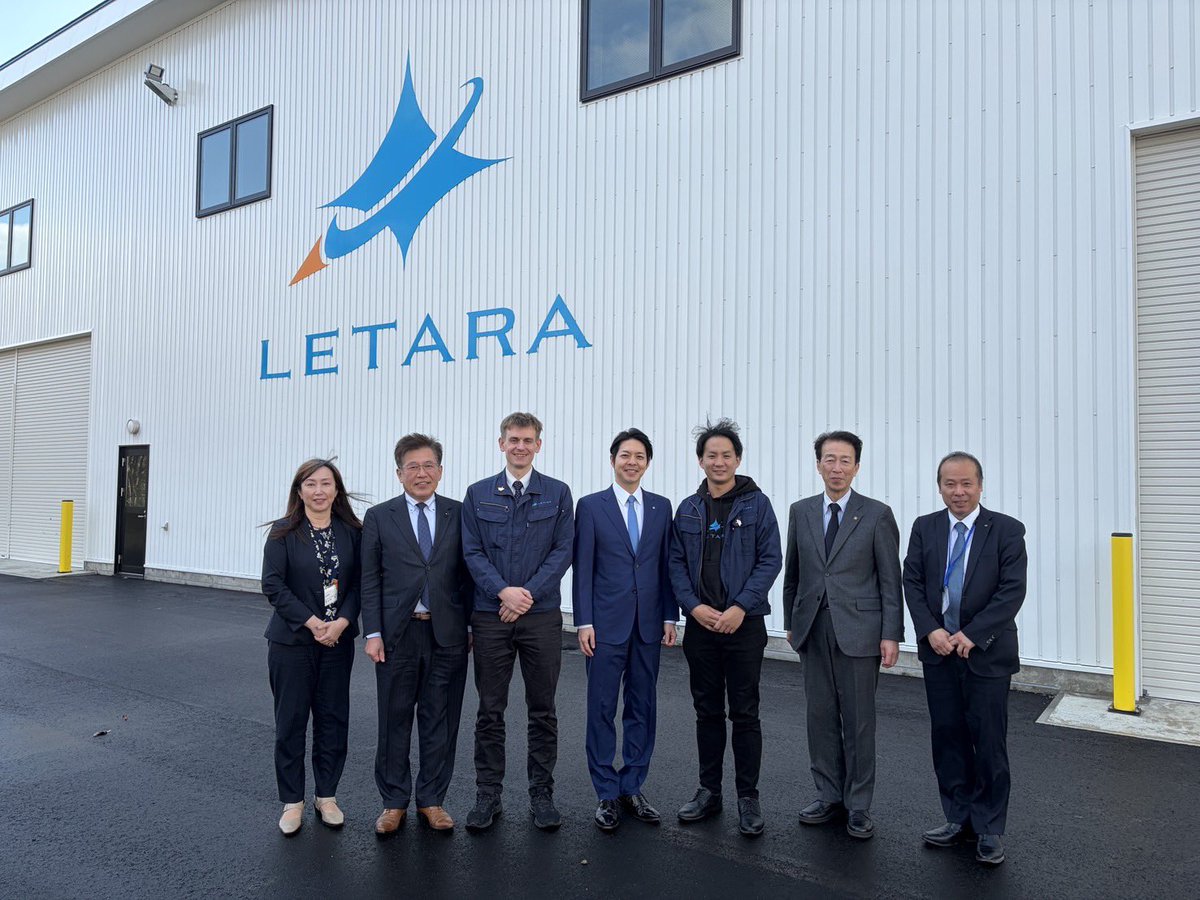

Letara’s new funding changes the company’s addressable market, shifting it from small-satellite thrusters toward propulsion for larger spacecraft, launch vehicles and defense users. The Sapporo-based startup announced ¥2.6 billion, roughly $16 million, in fresh capital that the co-CEO Shota Hirai says will fund product development and new use cases across space and security.
The round was co-led by Headline Asia, JIC Venture Growth Investment and Incubate Fund. Strategic participants include NES (Networked Energy Services) Corporation, Toyoda Gosei and Frontier Innovations, the latter an investment fund managed by Frontier Innovations and backed by the Japan Aerospace Exploration Agency. Hirai framed the raise as the step that will move the company past demonstrations, saying, “With this round, we will go beyond demonstrating that thruster in space,” and “We plan to explore a much wider set of use cases across both the space domain and the defense and security domain, and to develop and propose hybrid rocket systems suited to each of them.”
Letara’s propulsion approach uses a hybrid architecture that keeps solid fuel separate from the liquid oxidizer. Instead of costly paraffin wax, the startup relies on common materials such as plastic and rubber, processed through a proprietary method that mixes, shapes and compresses fuel to improve ignition reliability and burn consistency. The company claims that yields more thrust with less waste than some traditional hybrids, and it is explicitly targeting three technical limits that have constrained hybrid adoption, generating sufficient thrust, maintaining steady performance, and controlling combustion, Hirai said.
The commercial case is measurable. Market projections in the company’s reporting show the global hybrid rocket propulsion market expanding to $2.6 billion by 2032, from $848 million in 2024, a compound annual growth rate of 15 percent. Letara will enter a crowded field, with competitors developing hybrid systems across Asia, Europe, Australia and the United States, including Interstellar Technologies, Galactic Energy, InnoSpace, Equatorial Space, HyImpulse and Gilmour Space.
Letara traces its origin to propulsion research at Hokkaido University and was spun out in 2020. Founders Landon Thomas Kamps and Shota Hirai built the company around hybrid rockets partly for their perceived safety and simplicity compared with other architectures. The firm says it already has orders from rocket and satellite firms and the Japanese government, though it declined to disclose contract values.
The next technical milestone is an in-orbit firing test with an overseas partner, which Letara views as essential to commercial credibility. Beyond that the company must prove repeatable manufacturing with robust quality controls, and secure a supply chain for fuel and tanks capable of scaling production. When asked whether recycled plastic could eventually serve as fuel, Letara described that outcome as “very much a possibility,” while noting that additional testing and development will be required.
If Letara meets those milestones, it could present a lower-cost hybrid option to satellite makers, launch providers and government buyers. Failure to industrialize the design or to pass operational tests would leave the company competing for a narrow niche among many firms chasing the same propulsion premium.