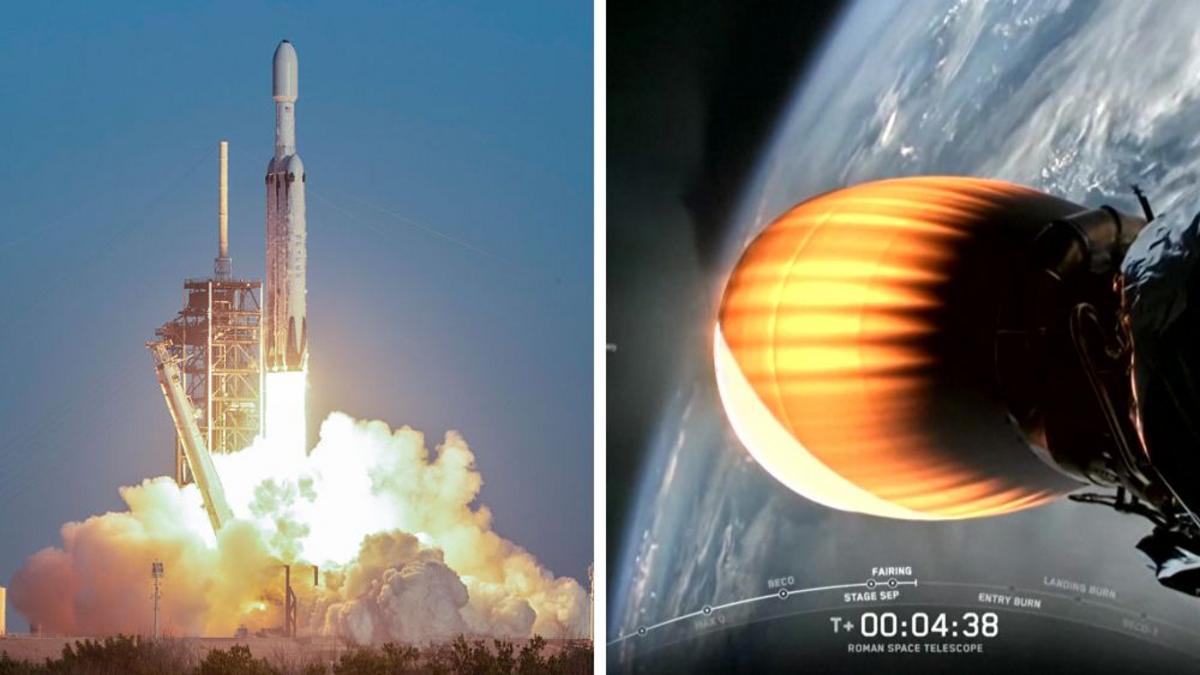

What happens next: the Nancy Grace Roman Space Telescope has begun a multi-year mission to map the cosmos from a point roughly one million miles from Earth, and to search for thousands of previously unseen worlds.
The telescope lifted off from Kennedy Space Center on a SpaceX Falcon Heavy rocket on Sunday local time, then separated from its launcher about 30 minutes later and started a 100-day transit toward its distant observing location. Project staff described a clean launch; Jackie Townsend, a project manager on Roman, called it, "What a glorious dawn launch," and said, "The ride was magnificent. It put us right where we wanted to be."
Roman's defining capability is its field of view. Nasa says the instrument will capture panoramic surveys covering 100 times the sky area of both the Hubble and James Webb space telescopes. That sweep is designed to let scientists map billions of galaxies across cosmic time, probe the forces labelled dark matter and dark energy, study black holes, and chart objects from the solar system to the edge of the observable Universe.
Exoplanet science is a central aim. Nicky Fox, a Nasa administrator, said, "Roman is going to change the way we look at the Universe," and added it could "discover tens of thousands, maybe even 100,000 new exoplanets." Astronomer Jenifer Millard noted Roman will sit about four times farther from Earth than the Moon, so infrared cameras do not pick up interfering heat from the Moon and Earth, and said the mission will help create "enormous cosmic maps." She compared those maps to an onion, allowing researchers to peel back layers and see how galaxy distributions evolve, a key to testing theories about dark matter and dark energy.
The telescope carries the name of Nancy Grace Roman, Nasa's first chief astronomer and a pivotal figure in the development of the Hubble Space Telescope. Roman helped secure Hubble's approval in Congress, and she later identified dark energy as one of Hubble's most striking discoveries. The new spacecraft has a five-year primary lifespan and a goal to operate for 10 years.
The mission now enters a precision commissioning phase during the journey to its observing point, after which Roman will begin its wide-field surveys and exoplanet searches. President Donald Trump dialled into the post-launch news conference to praise the team, saying, "You're the hottest in space, and we have the hottest country anywhere in the world." The next months will determine how quickly Roman reaches full science operations and begins to deliver the deep, wide maps Nasa expects.