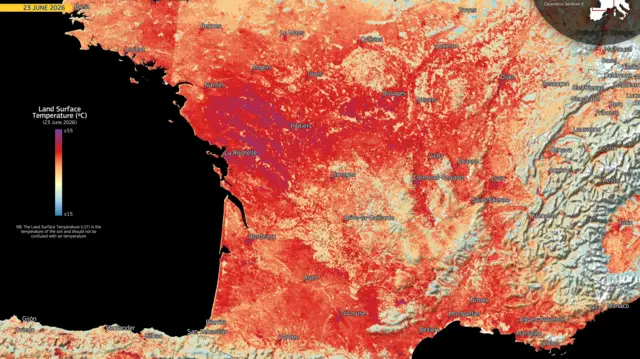
As Europe sweltered under a major heat dome, the UK recorded its hottest day of the year so far, with a provisional temperature of 38.1C in southern England. The thermometer at Kew Gardens in west London surpassed the previous high of 38C on 28 June, according to the Met Office. In France, which has recorded 17 days of extreme heat, Bordeaux reached 39C and Nantes 37C, while Paris was on 37C and Montpellier 35C.
In Spain, a maximum of 42.4C was recorded at Miranda de Ebro, prompting fresh fears of wildfires in the two countries. The UK's Charlwood in Surrey recorded 37.1C, the second highest August maximum temperature since 2003. An amber extreme weather warning was issued across east and south-east England, including London, the Midlands, north-west England, south-west England and parts of Yorkshire and Humber.
The Met Office has said this summer is on course to be the UK's hottest since records began, with 2026 likely to be the first year in which the country has recorded four separate days with temperatures of 36C or above. Spain has broken its burned area record for this time of year, while in France, the area burned had already surpassed that of any full year on record by the third week of July. Firefighters in the UK continued to tackle a blaze in the New Forest in Hampshire, as warnings about a very high risk of wildfires were issued across parts of eastern and southern Scotland.
Record dry conditions in July and a dry start to August have left nearly three-quarters of England and the whole of Wales in drought, heaping pressure on water resources for households, agriculture and the environment. In mainland Europe, record-low water flows on the Danube have deprived thermal power plants of cooling water, forcing some to reduce output as electricity demand for cooling grows. Romania stopped the second of two reactors in its only nuclear power plant, which supplies about a fifth of the country's electricity, due to the heatwave.
The human-driven climate crisis is primarily the result of burning fossil fuels, which releases greenhouse gases that trap heat, raising temperatures. Julia King, the peer who chairs the adaptation work of the Climate Change Committee, has said extreme weather "gets worse from here" until net zero is reached. Doctors consider heat a "silent killer" because it greatly increases mortality rates while only occasionally being listed as the direct cause of death. In Germany, public health officials estimate that 12,500 people have died as a result of the heat so far this summer.
NHS staff working in A&E departments across England have experienced their busiest summer ever, health leaders said. The Royal College of Nursing said its members were working in inhumane conditions, "dripping with sweat from head to toe" during the record-breaking heat. The water industry regulator, Ofwat, said it would allow water companies in England and Wales to increase bills to spend £3.4bn more than planned to meet supply demands, including for the building of new homes and datacentres.
As the heatwave continues, the UK and Europe are likely to face further challenges in the coming days. The Met Office has issued an extreme heat alert warning of significant impacts on health and social care services across the whole of England, which is in place until 9pm on Friday. With the climate crisis showing no signs of abating, the need for urgent action to reduce greenhouse gas emissions and mitigate the effects of extreme weather events has never been more pressing.