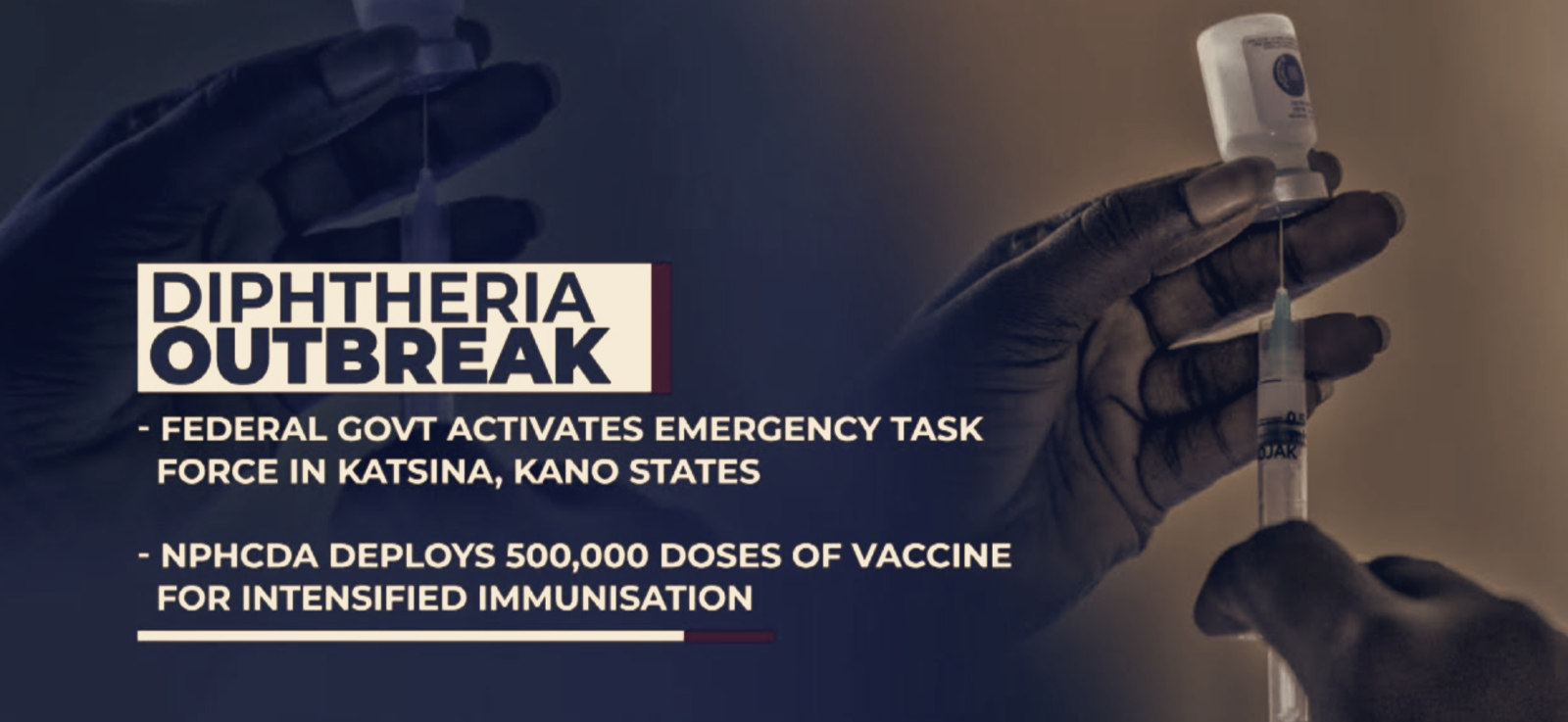

Residents of Katsina and Kano face a changed response after the Federal Government activated an emergency task force and positioned 500,000 vaccine doses to the affected states.
The action, announced from the capital, pairs vaccine deployment with an expansion of treatment centres in the two states. The government’s move shifts the immediate burden of the outbreak from overstretched local clinics toward a centrally coordinated campaign, and signals a rapid escalation of federal involvement.
The vaccine figure, 500,000 doses, is the clearest operational step disclosed so far. Those doses are intended for the outbreak zones named by authorities, Katsina and Kano. Alongside injections of supplies, officials have moved to increase clinical capacity by expanding treatment sites, a response likely aimed at isolating cases and reducing fatalities.
How quickly the vaccines reach communities, and how efficiently treatment centres scale up, will determine whether the escalation controls transmission. Logistics, staffing and cold-chain capacity present immediate constraints for any rapid immunisation drive. Local health services will need clear distribution plans and monitoring if the federal doses are to translate into protection for children and adults at risk.
The task force represents the instrument for that coordination. Its priorities will include overseeing vaccine distribution, directing resources to newly expanded treatment centres and tracking clinical outcomes. Public reporting of immunisation numbers and case trends will be essential to evaluate impact, and to reassure families in affected communities.
The government’s intervention alters the outbreak equation by adding federal resources and an operational mandate. The next test is implementation: whether the 500,000 doses are delivered and administered fast enough to blunt transmission, and whether enlarged treatment centres can absorb rising patient loads. Authorities have set the framework; execution will decide if the response contains the outbreak.