
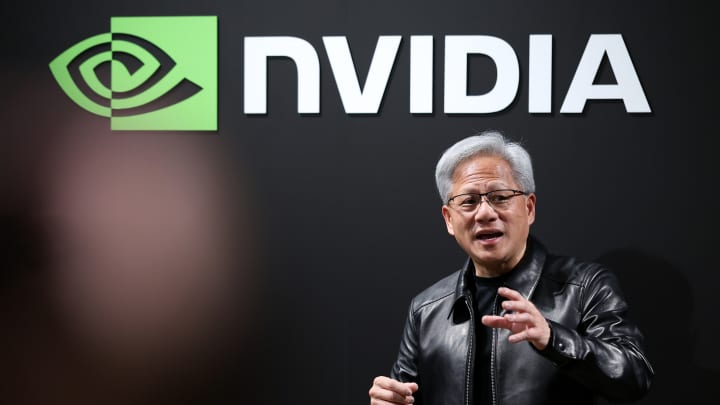
Jensen Huang's plan to unlock $500 billion in funding for AI projects by using Nvidia's graphics processing units as collateral faces a significant risk from China. The company has unveiled agreements with six major asset managers, including BlackRock and Goldman Sachs, to finance the construction of data centers and GPU clusters. However, the success of this plan relies on the assumption that Nvidia's GPUs will hold their value over time, which may not be the case if China ramps up its domestic compute capacity and floods the market with low-cost silicon.
Nvidia's GPUs are currently in high demand, with rental rates for its H100 chips rising from $1.7 per GPU-hour in late 2025 to $2.35 per GPU-hour this year. The company argues that its CUDA software layer enables developers to run AI workloads on its GPUs, improving hardware performance after deployment and allowing older chips to stay productive longer. However, Ben Emons, founder of FedWatch Advisors, notes that depreciation is a key risk, and Nvidia's chips could depreciate faster than expected, particularly if China engages in a price war.
Emons estimates that investors will demand high-yield returns in the 11% to 17% range to compensate for the risk of depreciation, which could make it difficult for borrowers to secure funding. Additionally, the borrowers are likely to be non-investment grade firms, including AI startups and neoclouds, which increases the risk of default. If these borrowers go under, Wall Street fund managers will be forced to repossess and resell used chips into a potentially falling market, which could lead to significant losses.
Despite these risks, Nvidia remains the leading supplier of AI chips in the US, with a market share of around 75%. The company's dominance is due in part to the US government's restrictions on the use of Chinese AI chips, including those produced by Huawei. However, China's growing compute capacity and potential to flood the market with low-cost silicon poses a long-term threat to Nvidia's financing model. The outcome of this situation will depend on who is right about the value of Nvidia's GPUs, and the future of the AI buildout, with hundreds of billions of dollars in investor money at stake.
The success of Nvidia's financing plan will also depend on the company's ability to continuously improve the performance of its GPUs, which will help to maintain their value over time. Huang notes that Nvidia's CUDA software layer enables developers to run AI workloads on its GPUs, which improves hardware performance after deployment. However, the company will need to continue to innovate and improve its products to stay ahead of the competition and mitigate the risk of depreciation.