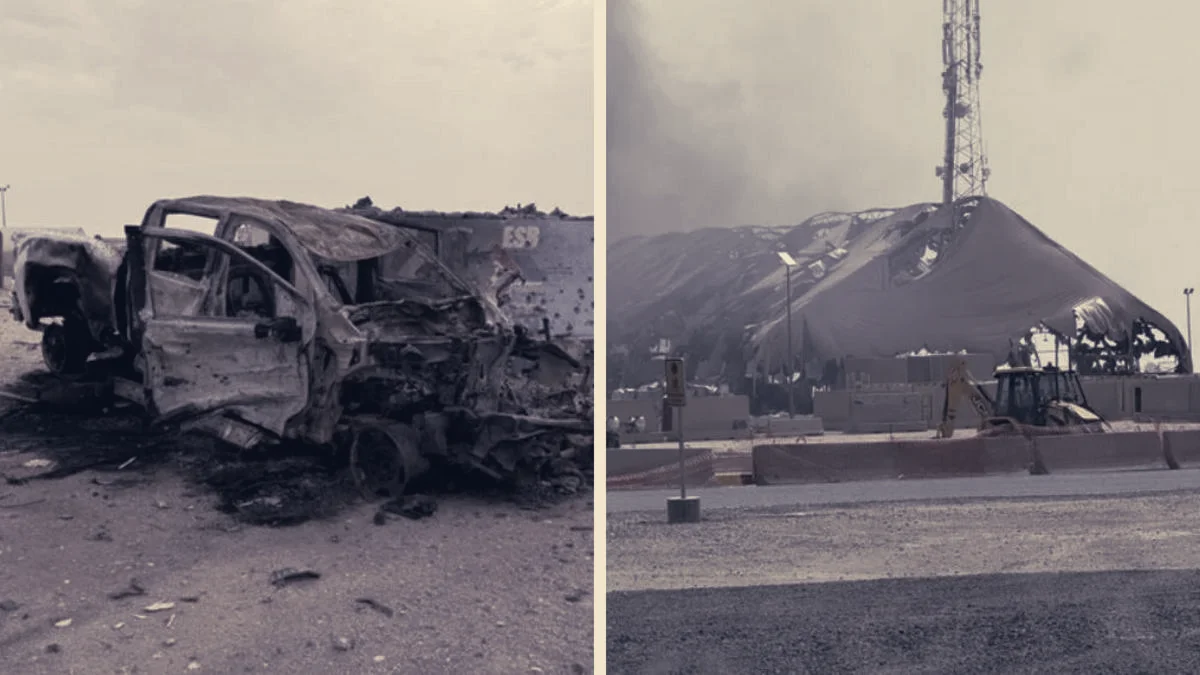
US military readiness and equipment stocks face renewed scrutiny after images circulated showing heavy damage at American sites in the Middle East. The photos, provided to CBS by active service personnel and reviewed by partners, depict a severed radar aircraft, crushed trailers and blown-out buildings at bases in Saudi Arabia and Kuwait.
The most striking image shows a Boeing E-3 Sentry at Prince Sultan Air Force Base in Saudi Arabia ripped in half, its tail section a tangled wreck. While the picture is undated, a visually similar image of the same radar aircraft was confirmed in March. The E-3 Awacs platform provides long-range detection and tracking, and the Congressional Budget Office noted the type is no longer produced, with a replacement model, the E-7, required. The CBO put the cost of a single E-3 at $500m (£371m) and estimated the total equipment losses from battle, including planes, drones and a terminal high altitude area defence system, at $1.9b (£1.4b), while flagging uncertainty because of incomplete Defence Department responses.
Other photos reportedly taken at Camp Buehring and Camp Arifjan in Kuwait show trailers flattened, a tent-like structure reduced to shreds with smoke rising, and a four-storey building with severe structural damage. The images have not been independently verified and are undated. An unnamed service member who spoke about the images said, "This is major damage to our bases that hasn't been communicated to the American public. We're standing there with our eyes closed getting punched in the face." The White House directed inquiries to US Central Command; Centcom did not immediately respond for comment.
Published alongside the photos was a Pentagon watchdog report that concluded hundreds of buildings and structures across US sites in Kuwait, Bahrain, Qatar, UAE, Saudi Arabia, Iraq, Oman and Jordan had been damaged or destroyed by Iranian strikes. The watchdog placed equipment losses at $3.7bn (£2.8bn) and recorded that the US had spent $33.4bn (£24.7bn) on the war through 29 June. The report also found that in the months after the conflict began, "dozens of US aircraft were destroyed or damaged", listing several types affected, including five refuelling aircraft hit on the ground in Saudi Arabia.
Brian Katulis, a Middle East Institute senior fellow and former national security official, said the images underscored shortcomings in US base defences and argued there is evidence adversaries may have assisted Iran in targeting. He warned of longer-term consequences, saying US assets had to be diverted from Asia to the Middle East, and that depleted munitions and equipment make other theatres and allies more vulnerable. Public and political pressure on the White House to seek an end to the conflict has increased.
Questions remain over the full extent of damage, the timeline and scale of repairs, and how quickly replacement equipment can be procured. The watchdog and CBO reports underscore both a substantial bill for lost materiel and continuing uncertainty because of incomplete information from defence officials. Centcom's response and any formal US plan to rebuild or reposition forces will determine whether the images mark a brief operational setback or a longer erosion of US regional posture.