
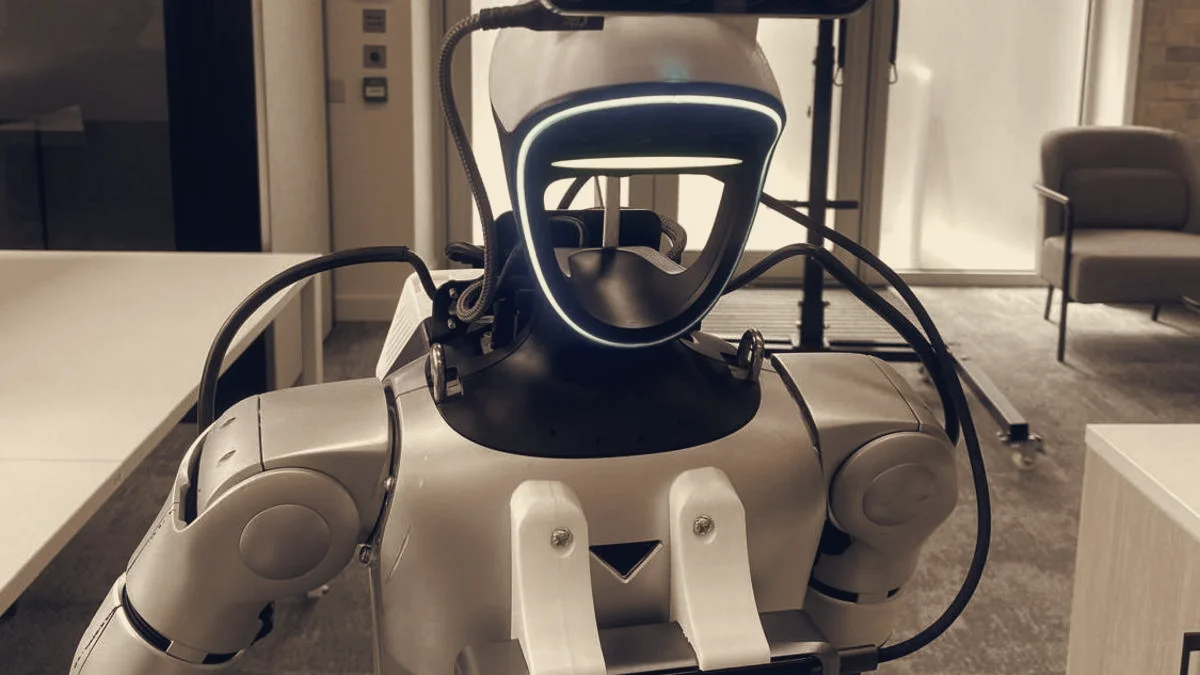
Robotics development for basic navigation and manipulation can be compressed from days into minutes, Vsim’s founders say, a change that could speed iteration for teams building physical robots. The Cambridge start-up demonstrated a robot called Freddo learning to walk, recognise a plastic bottle and grasp it after only minutes of simulated training, according to Michelle Lu and Kier Storey.
Lu and Storey built the simulator specifically to run on graphics processing units, the chips that also fuel modern AI workloads. They argue older simulation algorithms were poorly matched to that hardware, and Lu says, "The underlying algorithms that we were using for most of these robotic simulations they hark back to the 1970s and 1980s, but those algorithms are not really brilliant fits for GPUs." That redesign, she adds, let the team push simulation speed well beyond the tools they had used before.
Within months the software outpaced prior systems and the founders report a production-grade engine after a sustained effort. Lu said, "Eighteen months in and we actually have a completely functional, super high-performance simulator." The platform is small and efficient enough to run on Freddo's onboard hardware, allowing the robot to carry out tens of thousands of simulated trials while it moves.
Storey highlights how that scale helps planning in dynamic settings, saying the system "can look about a second, or so, ahead into the future for 20,000 different kind of combinations of things that might happen." The capability, the founders argue, is important for robots that must operate around people and unpredictable objects.
Vsim is a compact team of 10 engineers. At the other end of the market, Nvidia pairs dominant GPU supply with robotics software such as Isaac Sim and a world model called Cosmos, and its product lead for robotics flags a remaining limitation: short manipulation steps are manageable, but longer, multi-step tasks remain harder to solve. Nvidia has also begun using AI agents to speed up the creation and validation of virtual worlds, treating those agents as a scalable workforce for training environments.
Researchers at the University of Cambridge continue to use open-source options as well. Rika Antonova, an associate professor in the Department of Computer Science and Technology, works with MuJoCo, the simulator owned by DeepMind since 2021. She sees fast simulators as valuable because they let systems sample very large numbers of possible motions quickly, enabling near real-time adjustments to behaviour.
Developers note simulation is only one route to training — robots also learn from human demonstrations and recorded video — and that simulated worlds remain imperfect models of the real world. Long-horizon, multi-step manipulation persists as an unsolved barrier. For now, faster virtual training is narrowing the gap between experiments in simulation and practical robot behaviour, while core technical challenges still require work.