
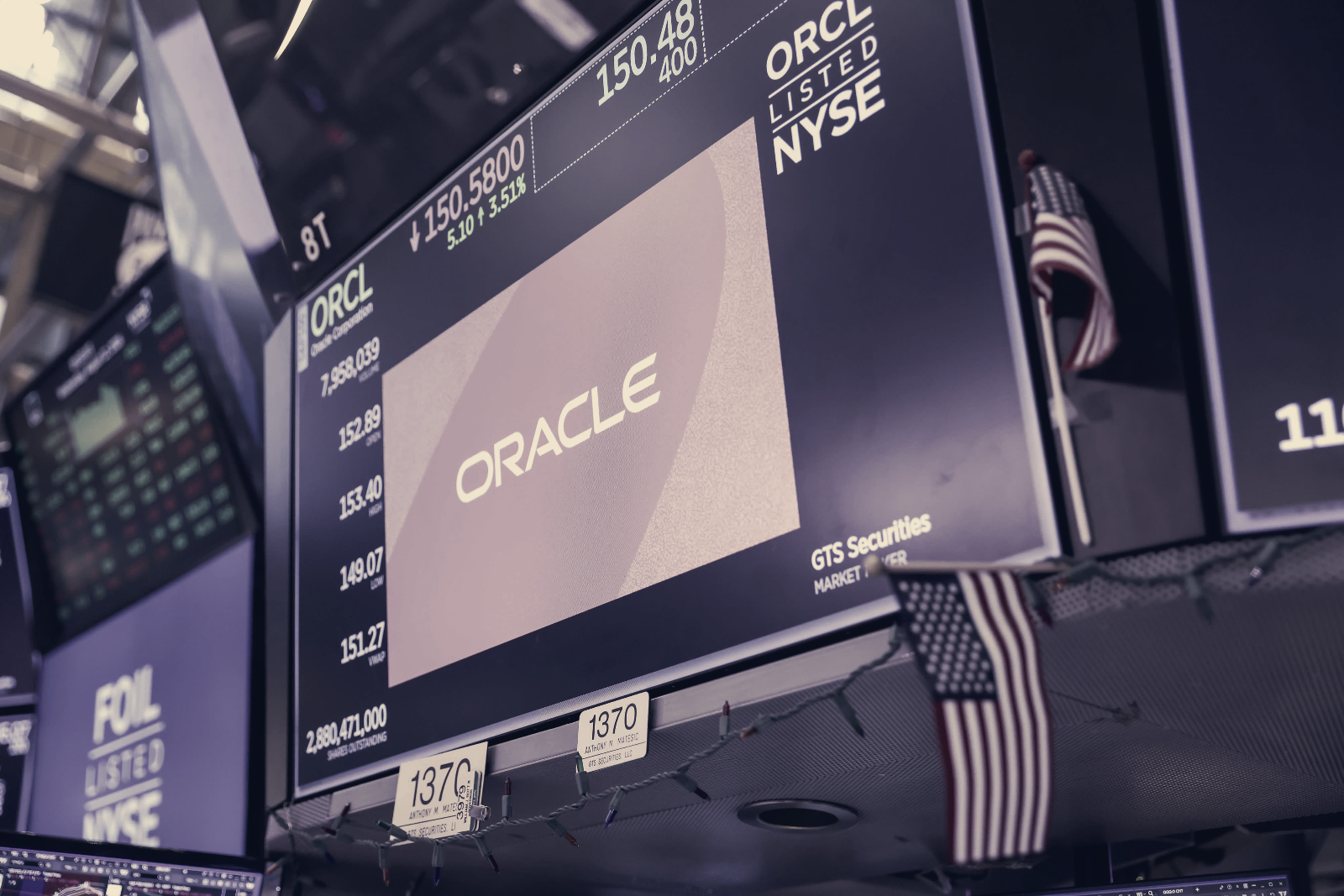
Investors face greater leverage risk after Oracle reported a 30% revenue increase for the fiscal first quarter while its total debt climbed to $125 billion, tied to an accelerated AI infrastructure buildout. The company posted $19.35 billion in revenue for the period, topping the LSEG consensus estimate of $19.14 billion, and net income rose to $4.7 billion from $2.93 billion a year earlier.
Oracle's cloud business drove the top-line advance. Cloud revenue grew 62% to $11.6 billion, led by a 121% jump in cloud infrastructure sales, while cloud application revenue increased 10%. Management said the quarter included sizable capacity additions and customer commitments that underpin the cloud expansion.
During the quarter Oracle added 850 megawatts of data center capacity and reported it has booked more than $30 billion in additional AI cloud contracts. The company also said it delivered over 300,000 graphics processing units to AI Cloud customers, naming clients including Nvidia, Meta, OpenAI, Advanced Micro Devices and SpaceX’s AI business.
The market reaction was mixed. Oracle's stock swung during the session, initially rising after the results and then finishing nearly 2% lower, and is down about 20% year to date as investors weigh the company's large borrowing against its growth trajectory. Free cash flow moved further negative, registering a $5.4 billion outflow for the quarter compared with a negative $362 million a year earlier, a shift that increases near-term liquidity pressure.
Oracle set second-quarter revenue guidance implying growth between 30% and 34%, and it expects cloud revenue to rise between 64% and 70%. The company also anticipates at least $90 billion in total revenue for fiscal 2027. Citi analysts maintained a buy rating after the report, saying Oracle had met expectations and had "cleared the runway" for its upcoming investor day. They added, "Oracle delivered a solid fiscal first quarter that checked nearly every box and reinforces the bull case," described the outlook for 2027 as "modest" while calling management’s framework "conservative," and concluded, "Given the magnitude of fiscal first-quarter outperformance, we see a favorable setup for upward revisions at Investor Day and AI World."
Oracle's results underline a clear trade-off: substantial top-line momentum driven by AI cloud demand and concrete progress on capacity buildout, paired with materially higher leverage and widening negative cash flow. That combination raises the stakes for the company's guidance and sets investor day as the next major test of whether analysts and shareholders will accept the financing burden as the price of scaling its AI business.