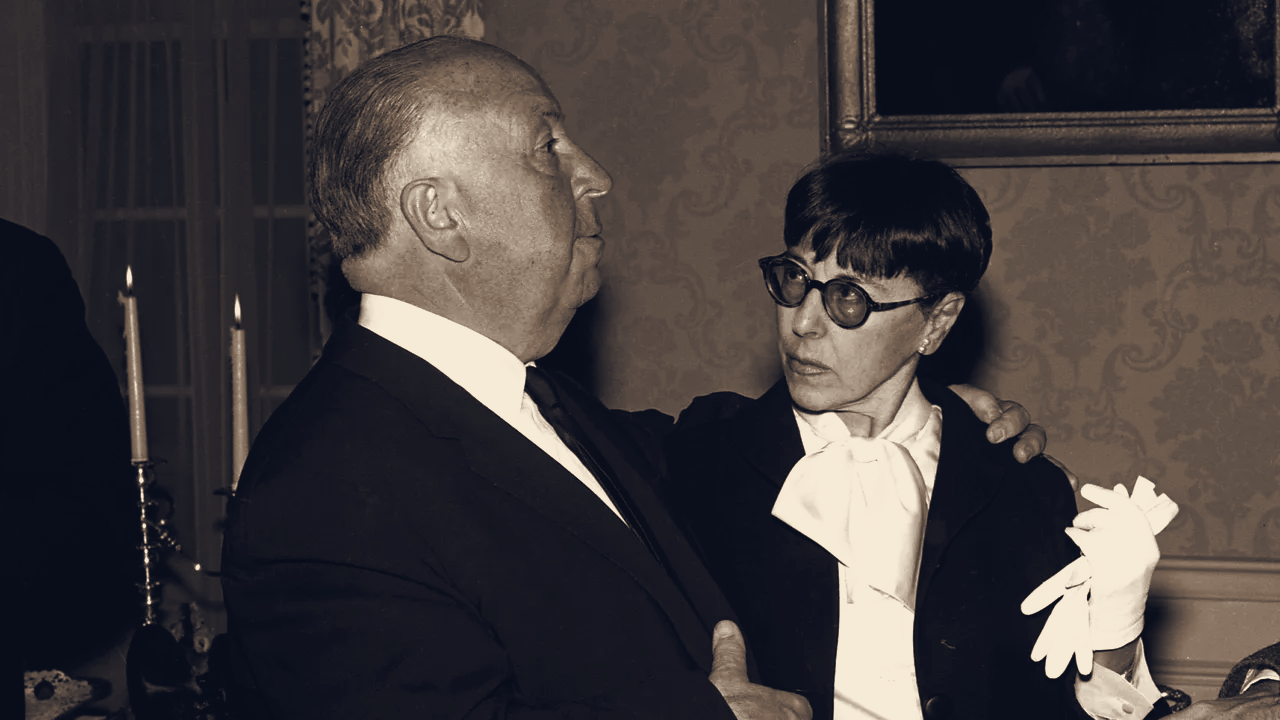

Alfred Hitchcock acquired a defining costume collaborator when Edith Head dressed Ingrid Bergman for 1946’s Notorious, a change that shifted how his films used clothing to signal character and plot. From the film’s opening porch scene, a small gesture around a handkerchief becomes a recurring coded object, a bit of business that Head clarified and extended through Alicia’s wardrobe. Costumes were no longer mere dressing, they became active props that tracked secrecy, seduction and moral change.
Head built Alicia’s arc in fabric and cut. Her early party looks, exemplified by a zebra-print top, read as flirtatious and permissive. Later, a white gown paired with a fur wrap marks enforced belonging inside the Sebastian household. At the story’s most precarious moment, a long black evening gown with medieval sleeves and a plunging neckline performs narrative work, shaping how the character moves and how the camera reads danger in a wine cellar. Those choices allowed the film to register deceit and risk without explicit exposition.
The match between director and designer was deliberate. Producer David O. Selznick weighed other names, among them Travis Banton and Mainbocher, before Ingrid Bergman, mindful of her screen image and Head’s prior work on For Whom the Bell Tolls and The Bells of St Mary’s, pushed for Head. Head later recalled to her biographer Paddy Calistro that she designed almost two dozen costumes for Notorious and had to ensure "what I did pleased Hitch," adding that Hitchcock insisted clothing "must not be a focal point, that Bergman was to be a believable secret agent."
Head also explained her technical thinking for black-and-white film, noting, "In a black and white film the eye is immediately attracted to the stark contrast of black and white, since other colors become various shades of gray," and describing the zebra stripes as emblematic of a "party girl with a notorious reputation." Those remarks capture how practical optical choices and symbolic intent merged in her work, turning prints, accessories and silhouette into instruments of storytelling.
Head brought a studio-honed craft to Hitchcock for the long term. She arrived at Notorious with a formidable résumé from Paramount, and over a near 60-year career she earned eight Oscars and 35 nominations. She went on to design for 11 Hitchcock pictures, including Rear Window, To Catch a Thief, The Man Who Knew Too Much, Vertigo, The Birds, Marnie, and the wardrobe for Vera Miles in Psycho. Hitchcock’s precise stage directions about movement and silhouette demanded a designer who understood dramaturgy, and Head met that demand.
The collaboration left a dual legacy: it altered Hitchcock’s visual signature and it gave costume design a reproducible method for storytelling in cinema. Decades on, fashion directors and designers continue to mine Notorious for cues, proving that Head’s first Hitchcock assignment changed both screen style and how designers translate character into cloth.