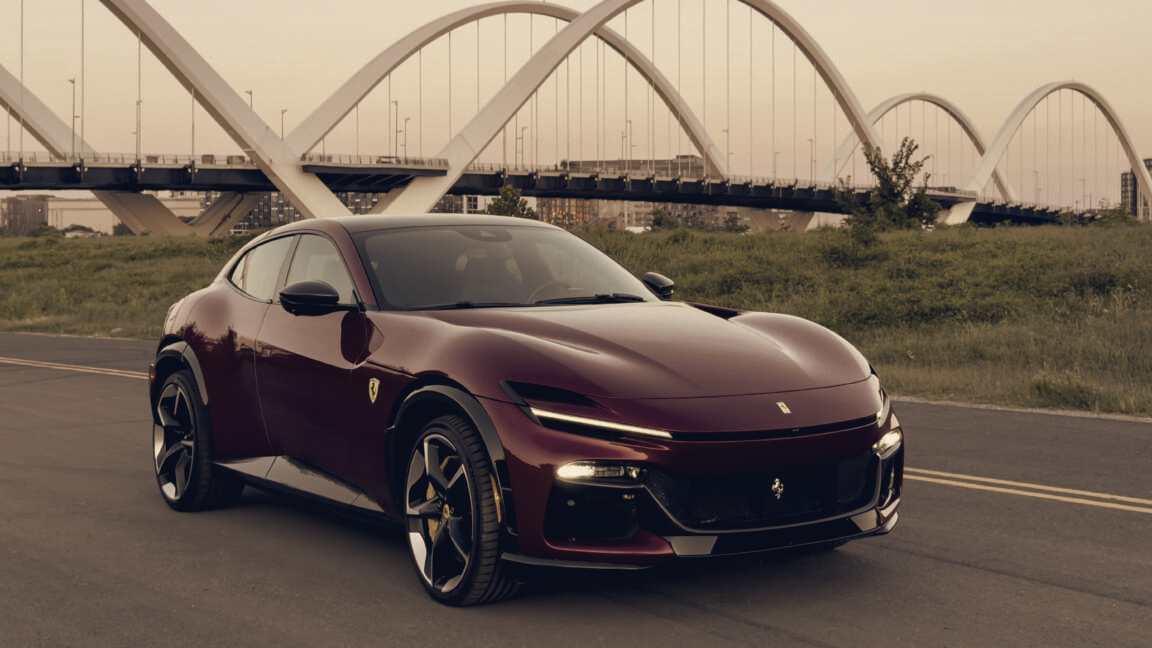
Rear passengers gain genuine space and direct access in Ferrari’s Purosangue, a shift from the brand’s earlier four-seat models that favoured cargo over human comfort. The Purosangue adds a second pair of doors, hinged at the rear, that open onto two dedicated bucket seats. There is still a rear hatch, which technically makes the car a five-door, but the cabin is separated from the cargo bay by an immovable firewall and the back seats do not fold flat.
That layout changes how owners will use the car. A supermarket run is feasible, but long, bulky items such as skis or bicycles will probably need a roof rack because the fixed passenger compartment limits cargo flexibility. Ferrari markets the model as an FUV, a Ferrari Utility Vehicle, rather than calling it an SUV.
Under the long bonnet sits a naturally aspirated 6.5 L V12 engine mounted rearward in the chassis, creating a front-mid engine arrangement. The package produces 715 hp (533 kW) and 528 lb-ft (716 Nm) of torque. Drive is sent to the rear via an eight-speed dual-clutch transaxle, while a separate power transfer unit at the front of the engine powers the front axle, making the car all-wheel drive. Those decisions help the car achieve a 49:51 front-to-rear weight ratio.
The Purosangue is substantial in size and mass. It measures 195.8 inches (4,973 mm) long, 79.8 inches (2,028 mm) wide, and 62.6 inches (1,589 mm) tall, with a 118.1-inch (3,018 mm) wheelbase. The curb weight is 4,784 lbs (2,170 kg). Those dimensions and that heavy V12 underline that Ferrari built this model to blend utility and the marque’s performance DNA.
The result is a practical rebalancing within Ferrari’s lineup: the new model gives rear-seat occupants meaningful accommodation while retaining a large displacement, high-output powertrain and all-wheel drive hardware. Buyers who need true cargo flexibility will find compromises, but those seeking a four-seat Ferrari that treats rear passengers like passengers rather than cargo get a clear upgrade.