
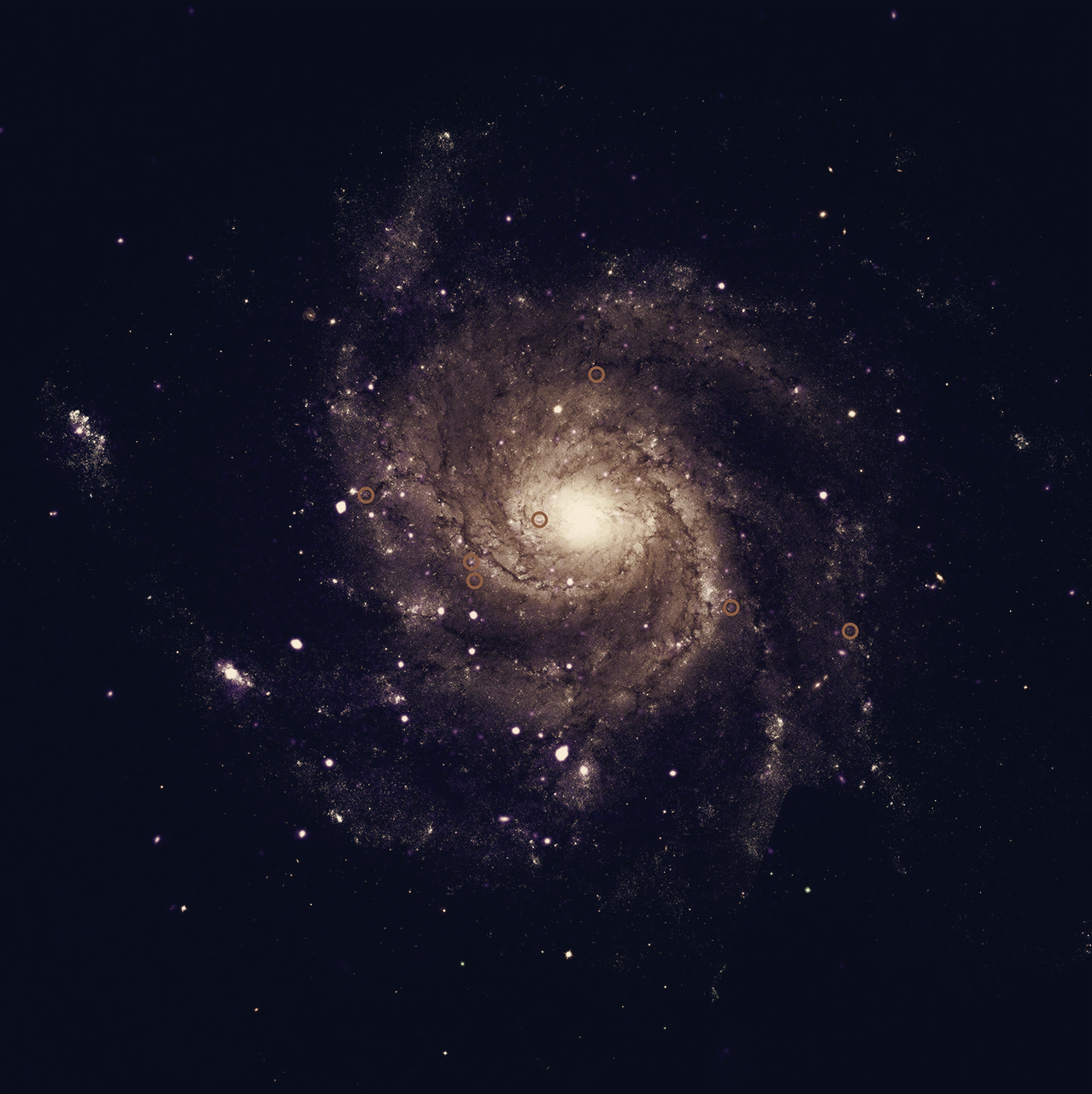
If a substantial fraction are accreting white dwarf binaries, they could reveal systems that later explode as Type Ia supernovae and introduce a new source of ionizing ultraviolet radiation in galaxies.
Researchers searched the Chandra X-ray Observatory archive and picked out 84 objects in six host galaxies, including the spirals M31 and M101 and four elliptical galaxies. The sources show up only at Chandra’s lowest X-ray energies and vanish at higher energies, a spectral signature the team describes as “hypersoft.” Because these very soft X-rays sit next to ultraviolet on the electromagnetic spectrum, the authors infer the systems also produce strong ultraviolet emission.
The finding appears in a paper published Wednesday in Nature Astronomy. The study’s authors argue the objects are compact binaries where a black hole, neutron star, or white dwarf accretes material from a companion. Similar binaries are known, but the combination of extremely soft X-ray spectra with intense ultraviolet output is newly recognised. “We’ve never encountered a group of objects that act like this,” said Mustafa Muhibullah of the University of Alabama, lead author of the study.
The ultraviolet implication matters for two issues. First, some accreting white dwarf systems are candidate progenitors for Type Ia supernovae, the explosions astronomers use to measure cosmic expansion but whose progenitor channels remain uncertain. “If we could find a way to spot these Type Ia supernova explosions before they go off, that would be really important,” said co-author Jimmy Irwin of the University of Alabama. Second, energetic ultraviolet photons can strip electrons from interstellar gas, changing cooling rates, chemistry, and the capacity for star formation. Hypersoft sources therefore offer an alternative contributor to ionization beyond hot massive stars.
The population was overlooked because very soft X-rays are difficult to detect and ultraviolet is readily absorbed by hydrogen and helium along the line of sight. “By combing through the Chandra archive, we were able to eliminate what used to be a blind spot for telescopes,” said co-author Rosanne Di Stefano of the Center for Astrophysics | Harvard & Smithsonian.
Next steps are targeted follow-up observations to determine the compact object types, test whether any of the systems are bona fide Type Ia progenitors, and quantify their combined ultraviolet luminosity and impact on galactic gas. NASA’s Marshall Space Flight Center manages the Chandra programme, with science and flight operations handled by the Smithsonian Astrophysical Observatory’s Chandra X-ray Center.