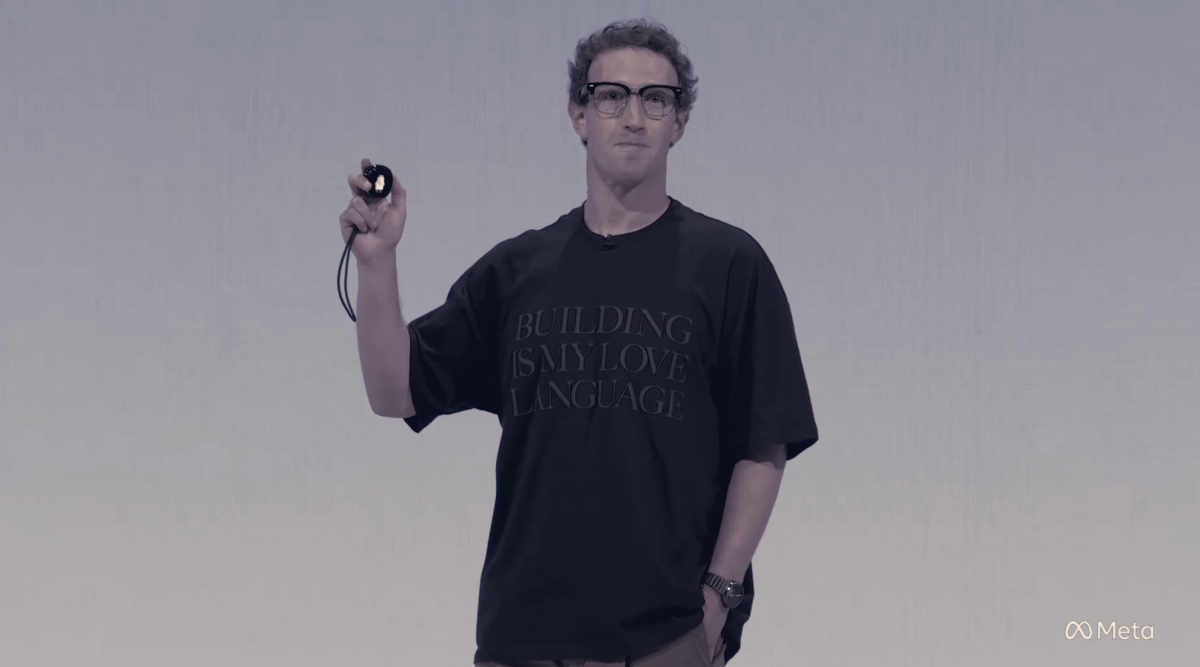
Users will be able to access Meta’s Muse assistant without unlocking a phone or opening an app, if the company meets its timetable. Meta introduced Muse Charm during CEO Mark Zuckerberg’s Connect keynote as a late-stage addition, describing a palm-sized wearable that clips to a keyring and carries the Muse agent in a tiny form. The company says the device will be ready to ship in time for the December holidays, making it an explicit play for gift-season demand and a fixed public availability target.
The Charm displays Muse’s avatar, internally nicknamed Jolly, on a small screen and is built for direct voice interaction. Zuckerberg framed the hardware as a compact delivery of the full Muse stack, saying, “We packed the whole Muse experience, including the whole real-time voice and avatar stack, into something that fits on a keychain and is always available to talk to.” He demonstrated a fingertip sensor and described how the touch activates immediate voice access, adding, “You just go ahead and tap here in the fingerprint sensor in the corner, and you can start talking without having to unlock a phone or open an app.”
Zuckerberg also acknowledged remaining hardware work and a short list of engineering tasks before production, telling the audience the team needed to “finalize laying out the components,” and he reiterated the promise that devices would be “ready to ship in time for the holidays in December.” That combination of a public deadline and visible engineering caveats gives observers a clear near-term milestone to verify.
The Charm keeps the launch deliberately consumer-focused, prioritising constant availability and personality over new sensor suites or input methods. Industry commentators have been sceptical about the category of standalone AI amulets after earlier entrants drew derision, and Meta’s strategy is to graft the established Muse software onto a low-friction physical object rather than introduce novel technical capabilities.
For Meta, the wearable is primarily a new distribution channel and a way to prototype how a persistent, personable assistant might fit into daily routines. The company did not promise features beyond voice access, so the device’s impact will depend on whether users adopt a separate always-on companion and on how Meta prices and distributes the Charm. The immediate next questions are whether Meta ships by December and how broadly it makes the device available.