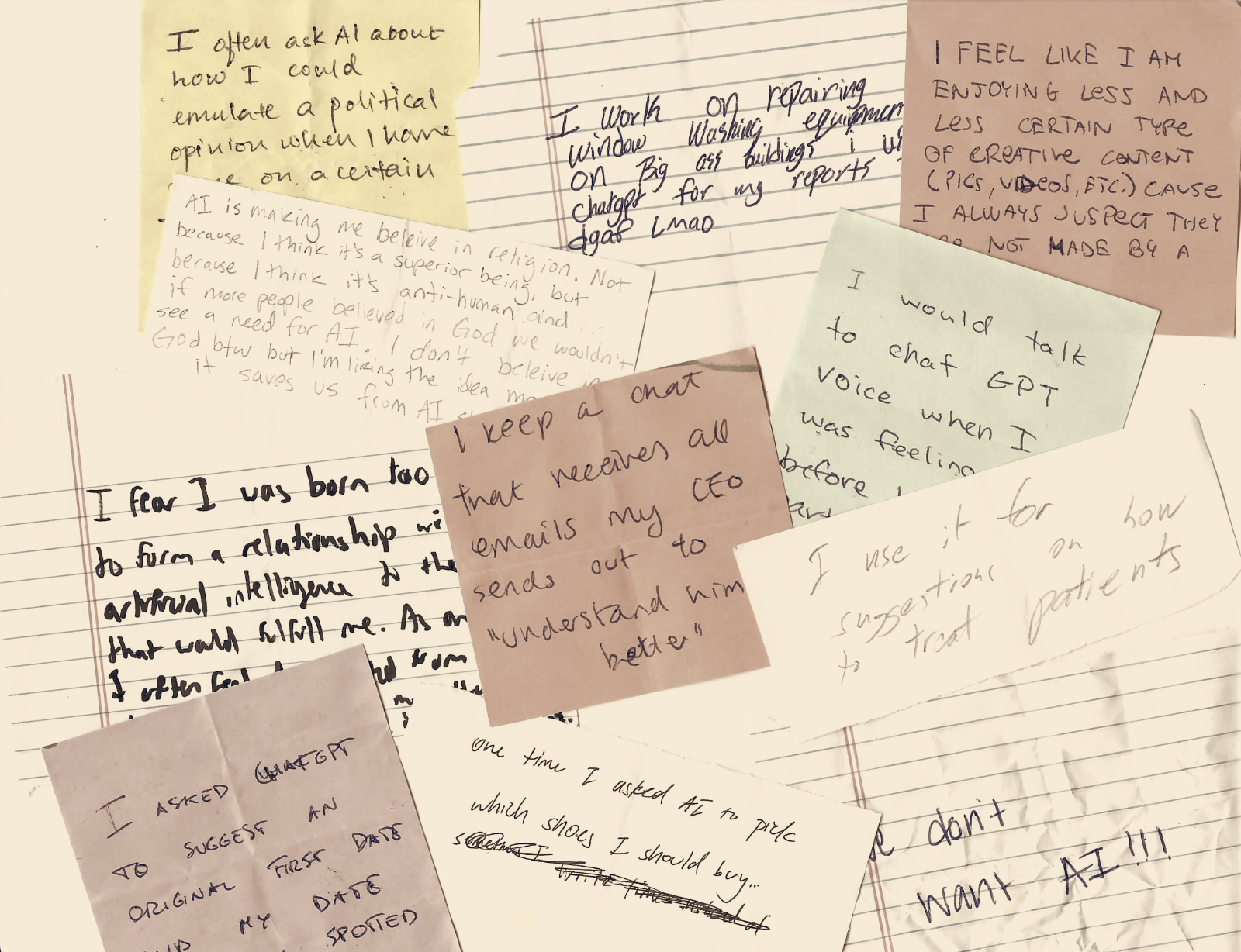

People are turning to artificial intelligence for intimate tasks and closure, an artist’s public confessions booth shows. Olivia Tai set up a DIY “Confessions Box” in September 2025 and has since collected more than 350 handwritten notes across more than 20 sites, documenting how people rely on chatbots for dating, breakups, work and emotional support.
Tai, 26, brought her project, What We Tell AI, to parks, malls, conferences and workshops in the Bay Area, New York City, Denver and beyond. The notes record a mix of pragmatic uses, like drafting messages or handling schoolwork, and deeply personal ones, including using AI to rehearse asking someone out or to simulate a last conversation with an ex. Tai said one early note crystallised the project for her, and from then on, "I just felt like I had to keep collecting these notes and seeing what people would say."
The confessions arrive amid rapid mainstreaming of chatbots. About half of U.S. adults now report using AI chatbots, up from the one in three who said so in mid-2024, and roughly one in four American adults use these tools every day, according to Pew Research Center. Public analysis of conversational datasets supports Tai’s findings: the AI Observatory examined over 24,000 annotated AI conversations from seven different platforms between 2023 and 2026 and found many exchanges focused on health and relationships.
Tai treats the collection as an "ethnographic snapshot" of a particular moment, not a representative poll. Still, the submissions reveal patterns: users under 50 are more likely to discuss emotional topics with chatbots, and some people report relying on AI more than they do on other humans. "Almost every person's history of interaction with an LLM is in private chat logs," Tai said, noting the secrecy that surrounds most AI use.
The confessions also expose tensions: some people feel shame about using AI for companionship or confess they leaned on AI to complete coursework, while others wrote that they avoid AI entirely out of fear. A poll by Elon University and The Washington Post found about 27% of Americans use chatbots for personal, emotional or social topics, and nearly four in 10 of those users say they have told a chatbot things they would not tell another person.
By staging the work in public, Tai forces a visible, human record of private behaviour. The project has already prompted listeners at workshops to read anonymous notes aloud and confront norms that have not kept pace with technology. Tai plans to keep collecting submissions, letting the archive grow as a record of how people adapt social and emotional life around AI, while leaving open questions about what those adaptations mean for relationships, education and workplace norms.