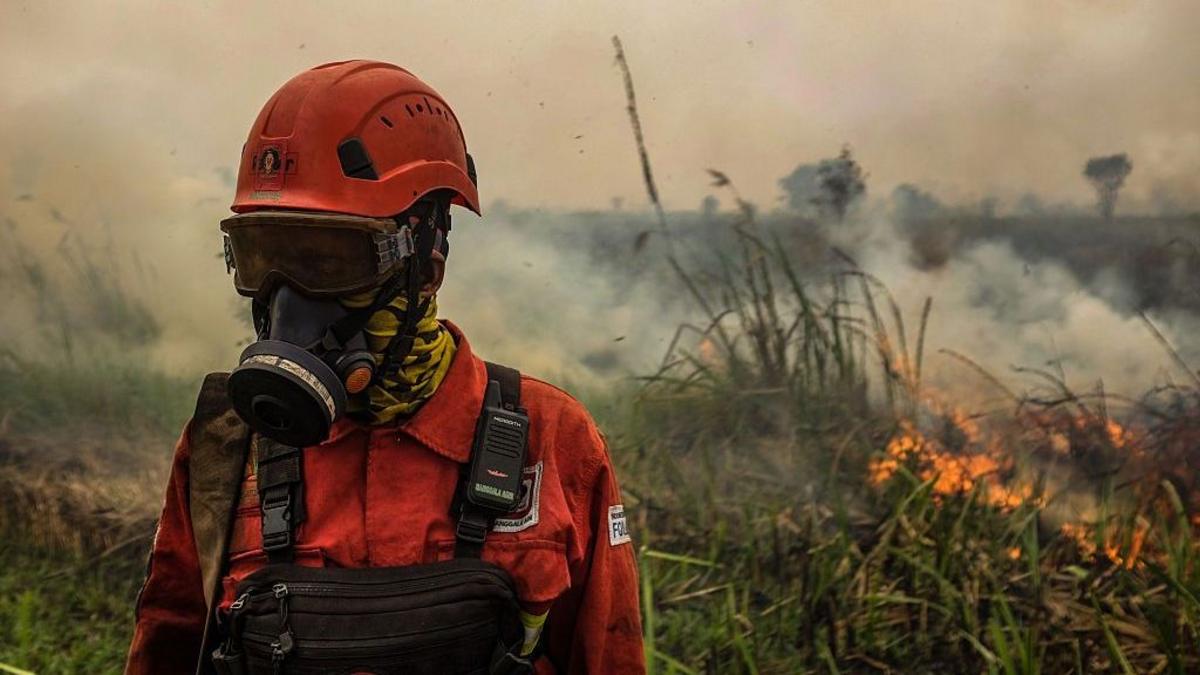

Millions are at increased health risk as a blanket of toxic haze from Indonesian wildfires spreads across Sumatra and Borneo into Malaysia, Singapore and the Philippines.
Air quality in some places has reached levels described as acutely unhealthy, more than 15 times the World Health Organization's recommended limit, as fires that began in mid-July continue to burn. Indonesian authorities recorded over 50,000 respiratory infections linked to land and forest fires between July and August, more than 12,000 of them children under five.
Residents described thick, choking smoke. Rizma Nur Fatimah, a 19-year-old teaching assistant in Banjarbaru, South Kalimantan, said the smog in her classroom had become so thick "you couldn't even see your own feet" and that "even inside the house, with everything closed, the haze still got in." A 23-year-old mother, Misbah, reported her three-year-old developed "a cough, a sore throat and a runny nose." In the Philippine province of Palawan, Dr Precious Bañas-Melad said, "We are now experiencing mild headaches," and that family members who were not previously allergic had begun showing symptoms.
Malaysia has also seen rising cases of asthma and conjunctivitis as smoke drifts across the border and degrades air quality nationwide.
Experts point to long-term land-use change as the structural cause behind recurring fires. Large-scale clearing since the Suharto era opened peatlands and forests to logging, plantations and development, and fires used to clear land have become associated with expansion of industrial plantations. Drained peat, timber estates and oil palm concessions make landscapes far more flammable, allowing fires to spread in ways that traditional, community-managed burns do not.
Peatlands add a second danger, both for climate and emissions. Dr Nisa Novita, a peatland researcher at Yayasan Konservasi Alam Nusantara, explained that under normal conditions peatlands act as vast carbon stores, but when drained or burned "they can become a 'carbon bomb' because that carbon can be rapidly released into the atmosphere."
The current event is taking place under a Super El Niño that is worsening drought across the region. Professor Bambang Hero Saharjo, a forest fire forensics expert, said last year without El Niño Indonesia lost 359,000 hectares to fires, and that this year's Super El Niño could burn as much as 11 million hectares, putting it on par with the 1997-98 season.
Indonesia's forestry minister, Raja Juli Antoni, signalled the crisis is at a critical point, warning that "our problems are not over. September is the peak of El Niño," and that "September is the main fight for us." With El Niño expected to escalate in the coming months, officials face an intensified firefighting effort and mounting public health impacts as the region heads into what scientists and authorities describe as a decisive period.