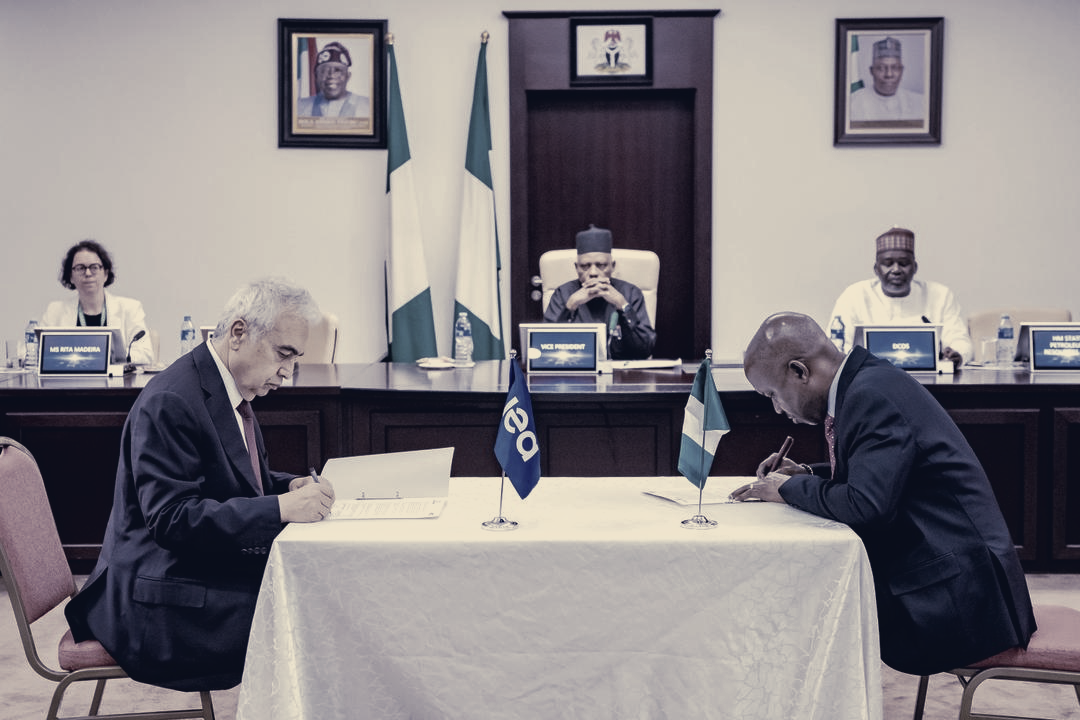

Nigeria will access the International Energy Agency’s technical expertise and global networks under a Joint Work Programme aimed at tightening energy statistics and mobilising investment across the sector. The agreement, disclosed by Stanley Nkwocha, Senior Special Assistant to the President on Media and Communications in the Office of the Vice‑President, was signed in Abuja in the presence of Nigerian officials and a Paris‑based IEA delegation.
Vice President Kashim Shettima described formal admission to the IEA Association framework as a major milestone, saying the partnership gives Nigeria access to the agency’s institutional knowledge as it presses ahead with energy‑sector reforms. The administration framed the move as recognition of Nigeria’s expanding strategic role in global energy markets.
IEA Executive Director Fatih Birol presented the agency’s remit as broad, spanning oil and gas, solar and nuclear, and extending to emerging areas such as artificial intelligence and electric vehicles. He said the IEA completed extensive assessments before the IEA Governing Board, which includes the United States, Japan, Germany, Italy and the United Kingdom, unanimously approved Nigeria’s admission.
Under the programme the IEA will provide policy advice and targeted technical assistance in areas including clean cooking, gas markets and capacity building for Nigerian energy professionals. Minister of State for Petroleum Resources Ekperikpe Ekpo said the Joint Work Programme will supply technical support to build reliable energy data, which he called essential to guide decisions across the country’s energy value chain.
Ekpo argued that improved data, backed by the IEA, should support economic growth, raise energy security and make Nigeria more attractive to investors. He linked the country’s admission to reforms carried out by the Tinubu administration, noting the Nigerian Upstream Petroleum Regulatory Commission attributes more than $10 billion in unlocked upstream investment to those changes.
The admission follows the IEA’s wider assessment of African upstream trends, which found investment fell to $37 billion in 2025 from $68 billion in 2016, and noted that Algeria, Angola, Egypt, Nigeria and Libya accounted for most of the continent’s production and investment over that period. Nigeria also completed a 2025 Licensing Round that awarded 37 blocks to 31 companies.
Officials say the Joint Work Programme should deepen cooperation and translate international expertise into practical reforms and capacity development inside Nigeria. The IEA has previously said Nigeria could potentially double investment in its energy sector within five years, making implementation the immediate test of how quickly external support converts into fresh capital.