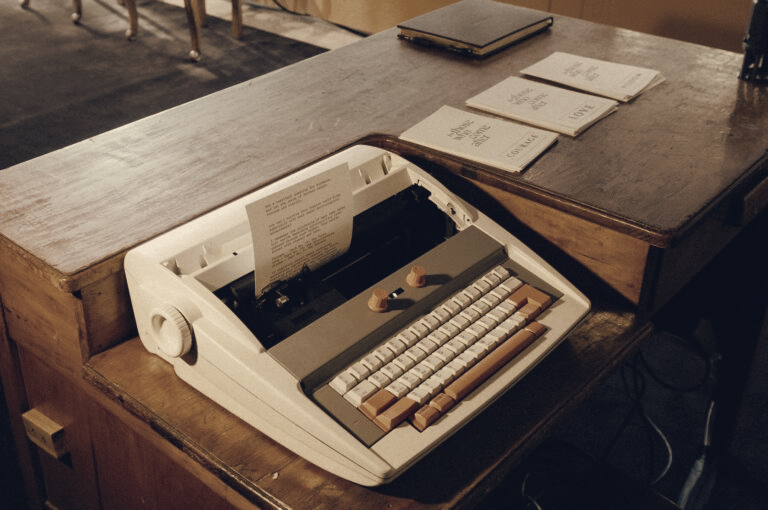
Visitors gain a mediated route into James Baldwin’s work through an AI-driven typewriter installed at a New York festival, an intervention built to foreground reading and reflection rather than to replace the author. The piece sits inside "For Those Who Come After," part of KIN: A Festival of Memory and Imagination, and places a desk, a mechanical typewriter, and three card stacks labeled Wisdom, Courage, Love at the center of its experience.
When a visitor asks the machine a question, bespoke software selects three cards from the stacks that the algorithm judges relevant to the prompt, then types a short, poetic reflection the project describes as emerging from the spirit of Baldwin’s archive. The room also reproduces Baldwin’s words through a radio, a television, and a record player, keeping the installation rooted in the writer’s own language rather than in synthetic mimicry alone.
The software and installation were built by Kinfolk Tech, a nonprofit that uses immersive technology, public art, and community-led design to centre displaced and excluded communities in memory work and storytelling. The organisation has produced augmented reality monuments of Black, Brown, Indigenous and queer figures, run fellowships on community memory, and supported archival projects focused on story preservation. Kinfolk’s founder, Idris Brewster, described the typewriter as "a 'poetic intervention' to slow people down long enough to reflect on the partnership between humans and machines."
The installation surfaces a broader cultural tension. The creator of this piece frames machine learning and generative models as tools for prompting contemplation and access, while other public debates around artificial intelligence remain dominated by louder, alarmist narratives driven by tech leaders and boosters. The artist-author who reported on the project admitted an initial recoil at coupling Baldwin’s name with AI, but concluded the emphasis in this work is retrieval and encounter, not erasure.
What happens next is an invitation: the installation asks visitors to reengage with Baldwin through curated prompts and archival fragments, and it offers a model for quieter, humanistic uses of LLM and machine-learning tools. At the same time the piece highlights how public distrust, shaped by powerful corporate voices, may make similar cultural experiments harder to mount and to receive.