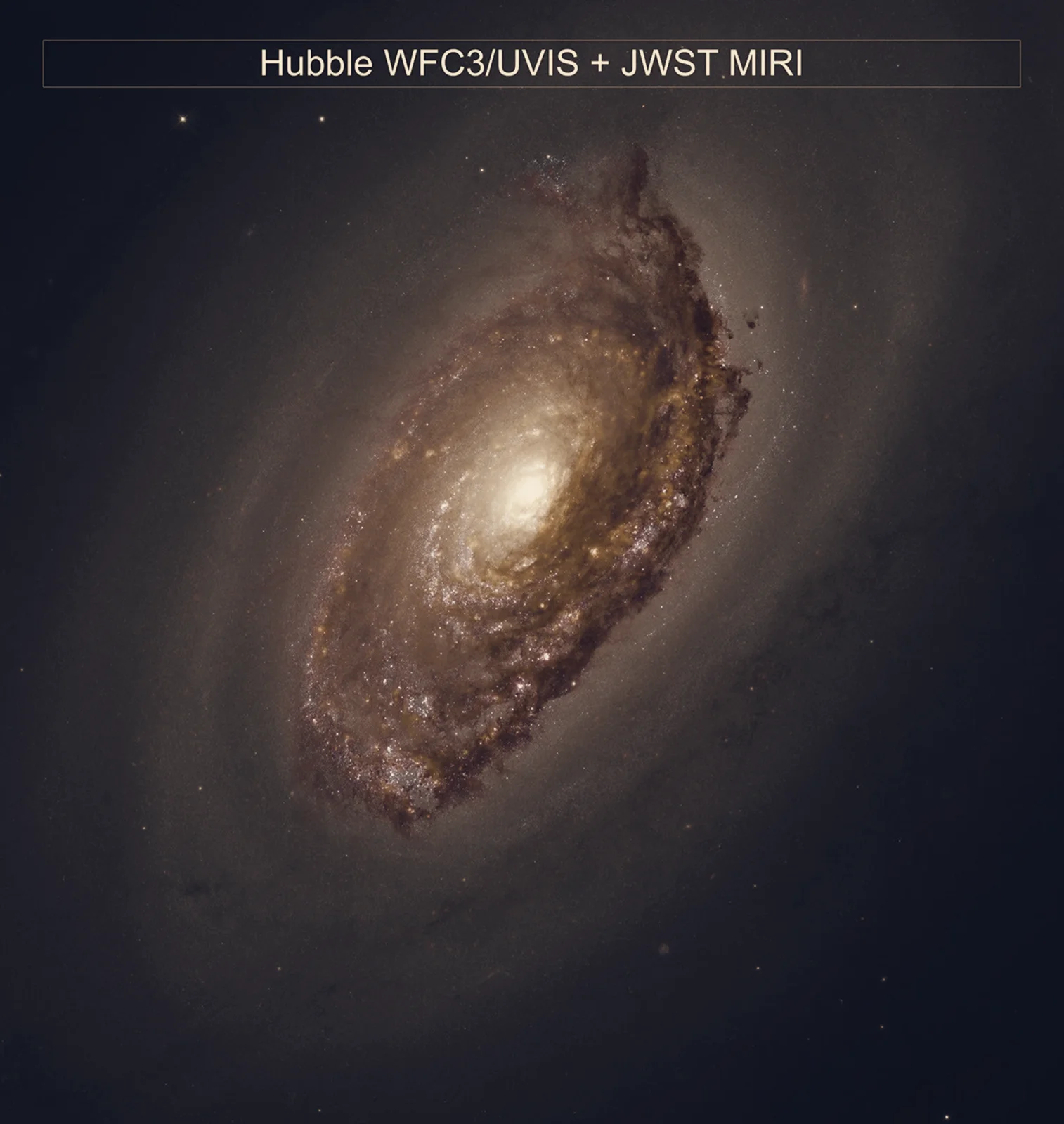
Astronomers gain clearer infrared detail on the Black Eye Galaxy, Messier 64, as Webb’s Mid-InfraRed Instrument captures dust emission that traces where newborn stars heat surrounding material. The composite images pair Webb’s MIRI view, which highlights dust re-radiating absorbed light in red, with Hubble’s optical view, where star-forming regions appear pink and young stars remain embedded in the gas.
The two instruments produce complementary perspectives. Hubble isolates the bright, optically visible star-forming pockets, while Webb penetrates the dusty lanes that partially obscure the galaxy’s luminous core. That dark band of dust that gave M64 its nickname is obvious to Webb as warm material glowing in the mid-infrared, a direct sign of dust absorbing starlight and re-emitting it at longer wavelengths.
M64 is notable because its inner and outer gas rotate in opposite directions, and where those gas currents collide, compression drives heightened star formation. Observers long suspected a past interaction, and the opposing motions of the gas point to a merger with a smaller galaxy as the likely trigger. By mapping dust distribution, composition, and motion, Webb delivers data that will help astronomers test that scenario and refine models of how minor mergers reshape spiral galaxies.
Beyond confirming active, merger-related star formation in M64, the new images illustrate how mid-infrared observations change what telescopes can reveal about galactic structure and evolution. Webb’s sensitivity to warm dust provides context for optical features and uncovers the embedded stellar nurseries that Hubble alone cannot fully reveal. The combined dataset will feed follow-up studies aimed at the galaxy’s dust chemistry, kinematics, and the timeline of its interaction.
For readers, the Astronomy Picture of the Day entry for September 16, 2026, presents this Webb, Hubble composite and notes that APOD’s main NASA site is moving from apod.nasa.gov to science.nasa.gov/apod.