
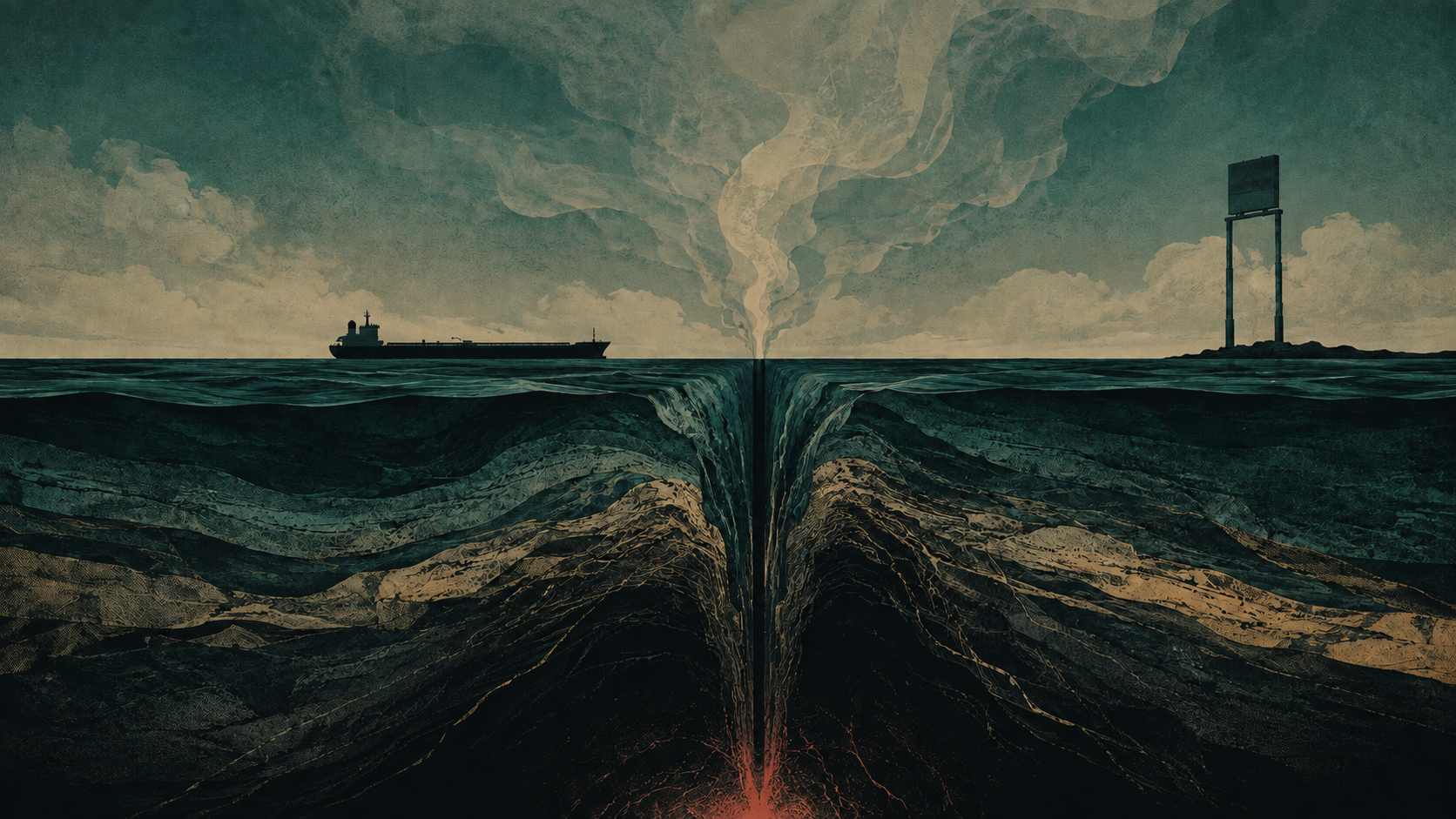
Near the end of the first century AD, Pliny the Elder recorded the destructive scale of Roman mining across northern Spain.
The Roman governor, philosopher and naturalist described hillsides being broken apart with iron wedges and hammers, while mountains were bored with corridors and galleries. Miners could spend months without seeing sunlight, and many died underground.
Once the rock had been hollowed out, Pliny wrote, miners could force a collapse by removing roof supports or flooding tunnels. He called the method Ruina Montium, or the fall of mountains.
“The stubborn” durability of rock, he wrote, was surpassed only by “the most stubborn thing of all, the hunger for gold.”
Pliny’s concern extended beyond the physical violence of mining. He saw an empire reaching into the earth for wealth, status and resources without fully confronting the cost.
“We trace out all the veins of the earth,” he wrote, “we penetrate into her entrails, and seek for treasures in the abodes even of the Manes.”
The environmental consequences of Roman extraction persisted long after the empire’s mines fell silent. The source notes that Roman copper production generated emissions that reached the Arctic troposphere and were later found in Greenland ice cores. At Wadi Fanyan in Jordan, one of Imperial Rome’s largest copper mines turned the surrounding area into an industrial wasteland, with metal contamination still found in plants and livestock.
For Pliny, the pursuit of hidden wealth carried a warning. He asked when the exhausting of the earth would end, and how far avarice would penetrate.
Extraction itself is ancient. Humans have removed materials from the earth for tools and survival for millennia. But the source argues that modern extraction operates at a different scale, driven by economic and financial systems built around perpetual growth.
It describes that convergence as a possible Ruina Planetae: a world at risk of lying in ruins before those who have extracted from it.
Exxon’s climate research
Nearly two millennia after Pliny’s account, Exxon began examining the consequences of the fossil-fuel economy on which much of its business depended.
In 1977, James Black, a senior Exxon scientist, told the company’s management committee that there was “general scientific agreement” that carbon dioxide released by burning fossil fuels was warming the global climate.
Black warned that a doubling of atmospheric carbon dioxide could raise average global temperatures by 2 to 3 degrees Celsius, with potentially much higher warming at the poles. He said some countries could benefit, while others could see agricultural output reduced or destroyed.
“Man has a time window of five to ten years before the need for hard decisions regarding changes in energy strategies might become critical,” Black said.
In August 1979, Exxon equipped the Esso Atlantic, one of the world’s largest oil supertankers, with a climate-monitoring laboratory. As the vessel carried oil between the Gulf of Mexico and the Persian Gulf, it also collected atmospheric and oceanic carbon dioxide samples.
The work formed part of a three-year, $1 million research project combining data gathering and climate modelling.
Exxon researchers were trying to determine how much carbon dioxide the oceans could absorb and what that would mean for future warming. If deep oceans absorbed carbon dioxide at a high rate, the company could potentially delay decisions on oil and gas production. If the absorption rate was low, Exxon’s scientists would have to deliver what one project manager called the “bad news”.
According to the source, that warning emerged through internal reports, memos and data sets. Exxon’s models projected sharp increases in atmospheric carbon dioxide and global temperatures, and have closely tracked observed changes over the decades that followed.
A 1982 Exxon environmental affairs document, circulated internally and marked not for external distribution, said preventing global warming would require major reductions in fossil-fuel consumption or risk “potentially catastrophic events”.
Internal correspondence debated the timing and severity of the effects. One 1981 exchange considered whether impacts by 2030 would be limited or devastating for a substantial fraction of the global population.
The turn towards uncertainty
Despite the company’s internal research, Exxon’s public messaging changed in the years that followed.
By 1988, company memos showed an effort to emphasise uncertainty in scientific conclusions about the enhanced greenhouse effect. That year, the Intergovernmental Panel on Climate Change was established to assess climate science independently.
Its first report, published in 1990, concluded that continued fossil-fuel use would make planetary warming certain and recommended emissions cuts of 60 to 80 per cent to stabilise atmospheric carbon dioxide concentrations.
Exxon’s chief climate researcher, Brian Flannery, argued during discussions over the report that the proposed cuts were too severe given what he described as uncertainties in the climate system.
The source notes that Flannery had co-authored a U.S. Department of Energy paper five years earlier projecting warming of up to 6 degrees Celsius by the end of the twenty-first century unless emissions were reduced.
In 1989, Exxon helped found the Global Climate Coalition, an alliance of energy companies and industry groups that spent the following decade opposing government action to curb emissions.
The coalition publicly highlighted debate over whether fossil-fuel use was driving a dangerous warming trend. It also produced a film claiming that increased atmospheric carbon dioxide would improve crop yields and help end world hunger.
Exxon chief executive Lee Raymond made uncertainty a central part of his public position. In 1996, he said scientific evidence was inconclusive on whether human activity was significantly affecting the climate.
The contrast between Exxon’s internal research and its later public messaging presents the central question raised by this history: how long can an economic system dependent on continued extraction postpone the consequences it has already identified?