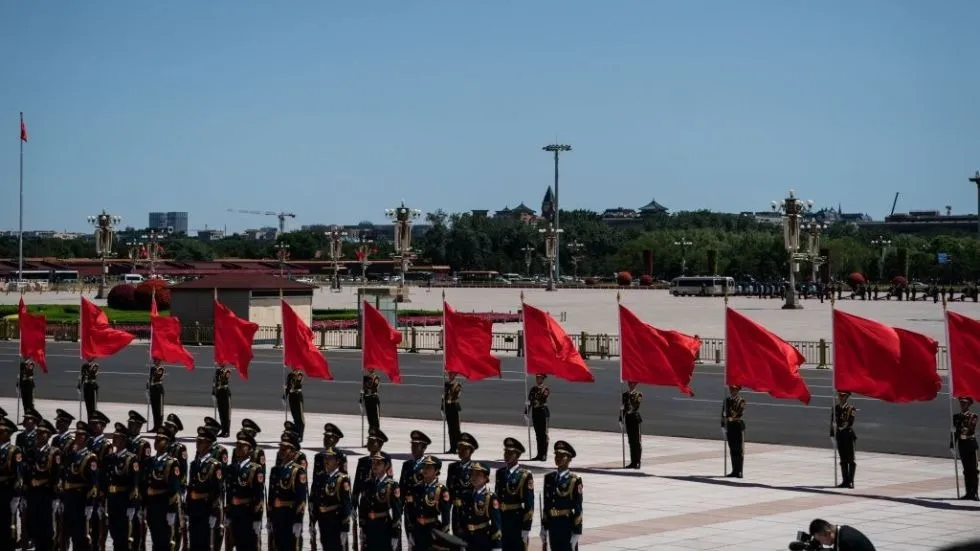
China shapes global knowledge not only by restricting information at home, but also by exporting censorship through economic coercion and diplomatic pressure.
Beijing is increasingly influencing what the rest of the world knows about its internal repression, territorial ambitions and political system.
Its strategy rests on three main pillars.
The first is corporate compliance. Beijing uses access to its vast domestic market to pressure Western companies, including Hollywood studios and the National Basketball Association, into avoiding topics such as Tibet, Taiwan, Xinjiang and Hong Kong in order to protect their commercial interests.
The second is platform control. Chinese-owned applications such as WeChat apply domestic censorship rules to overseas users. TikTok has also faced sustained scrutiny over allegations that its algorithms deprioritise or restrict content critical of the Chinese government.
The third is the suppression of independent scholarship.
Beijing uses economic leverage and the threat of denying visas, withdrawing funding from overseas Confucius Institutes or reducing tuition revenue from Chinese international students. Universities, think tanks, nonprofit organisations and academic publishers have all faced pressure intended to influence research on modern Chinese history and politics.
That pressure extends to scholarship involving Taiwan, Tibet, Xinjiang and the South China Sea.
Few cases illustrate this campaign against academic freedom more clearly than the cancellation of the International Association for Tibetan Studies conference in Kathmandu, Nepal.
The conference, widely regarded as the leading global gathering on Tibetan history, language, culture, philosophy and religion, had been scheduled to open on August 23.
Nepal’s government cancelled it on August 5 following pressure from Beijing.
Before the cancellation, the Tibetan Policy Institute, the think tank of the Tibetan government-in-exile, had already withdrawn in an effort to address Chinese concerns. Organisers had also repeatedly assured officials that the gathering would remain strictly academic.
Those concessions were not enough.
About 100 officials and researchers from Chinese state institutions, including the China Tibetology Research Center, had registered to participate.
The contrast exposes Beijing’s asymmetric approach to Tibetan scholarship. Independent Tibetan institutions are denied representation, while state-backed Chinese organisations gain greater influence over how knowledge about Tibet is produced and distributed.
The cancellation shows that Beijing’s influence now extends beyond shaping participation in academic debate. It can prevent that debate from taking place entirely.
It also demonstrates China’s growing leverage over Nepal, a country positioned between Chinese-controlled Tibet and India.
Beijing has repeatedly used economic incentives and diplomatic pressure to push Nepal to restrict Tibetan exile activity, suppress protests and impose tighter controls on Tibetan communities.
Chinese diplomats reportedly warned Nepali officials that the conference could become a platform for “anti-China rhetoric.”
That intervention reportedly outweighed the assessment of Nepal’s own security agencies, which concluded that the event posed no security threat.
The episode reflects a broader shift in how China exercises power.
Beijing is no longer content to censor discussion within its own borders. It increasingly uses diplomatic influence, economic power and political pressure to determine who is permitted to speak on the international stage.
This is a form of geopolitical competition centred not only on territory or markets, but also on authority over knowledge.
China is seeking to convert economic and diplomatic leverage into epistemic power: the ability to influence what others think, know and believe, and which narratives gain institutional legitimacy.
Academic freedom depends not only on the right of individuals to speak, but also on the existence of forums where competing ideas and institutions can confront one another.
When geopolitical pressure prevents those exchanges, the marketplace of ideas becomes distorted.
This should matter beyond Nepal.
The United States has spent years responding to Chinese influence by closing Confucius Institutes, increasing scrutiny of foreign ties among federal grant recipients and strengthening controls on sensitive research.
Beijing’s ability to influence the production of knowledge itself now deserves equal attention.
The imbalance in Tibetan studies is structural. Chinese state-backed institutions have access to resources, diplomatic support and international platforms, while independent Tibetan voices face exclusion.
That does not mean researchers from Chinese institutions should be barred from international scholarship. Serious academic work requires engagement across political systems.
The problem arises when state power determines whether debate can occur and which institutions are permitted to participate.
Academic conferences should be places where evidence competes with evidence, not forums where geopolitical pressure decides whether scholars are allowed to meet.
China’s larger objective appears to be the creation of pre-emptive self-censorship, narrowing what institutions, companies and individuals are willing to say, publish or study.
The contest over how the world understands Tibet, Taiwan, Xinjiang, Hong Kong, the South China Sea and China itself is intensifying.
Universities, publishers and scholarly institutions are becoming central battlegrounds in that struggle.
Knowledge is power. Those who shape accepted historical narratives, determine which voices are treated as legitimate and decide which perspectives are excluded acquire influence that can endure far beyond any single diplomatic dispute.