
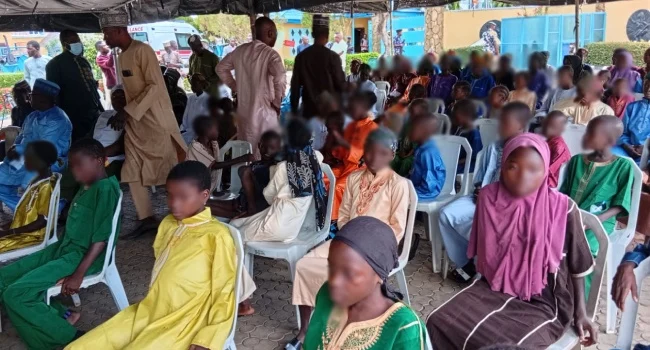
At least 13 captives died during the nearly six months in captivity, while 12 children were still being held by the terrorists, according to some of the rescued victims of the February 3 terrorist attack on Woro and Nuku communities in Kaiama Local Government Area of Kwara State. The victims, who were among the 176 women and children abducted when terrorists, believed to be Boko Haram, launched coordinated attacks on Woro and neighbouring Nuku communities, were formally received by the Kwara State Government after their rescue.
The attackers had razed homes, shops and the palace of the traditional ruler, while scores of residents were killed, and hundreds of gunmen riding motorcycles reportedly invaded the communities after residents rejected the group’s extremist ideology. The victims recounted their ordeal, saying they ate one meal a day and slept in the open forest. Nafisat Abdulfatai, one of the survivors, said several children remained in the forest because the abductors said they would become slaves if they attempted to leave.
Abdulfatai explained that although the captives were not routinely beaten or physically assaulted, they endured severe hunger and deprivation throughout their stay in the forest. The captives were not allowed to eat what they wanted, and most days, they ate only once, with meals prepared with only salt, and no oil or other ingredients. Many of them ended up eating things they never imagined they would eat in their lifetime. There were days when they had nothing to eat from morning until night, and sometimes, their only meal came around 7 p.m. or 8 p.m.
Describing the living conditions, Abdulfatai said the captives spent months sleeping in the open forest before being moved into a makeshift shelter after several children died. The makeshift shelter was erected with trampoline material, and the captives slept under that temporary structure like animals. Whenever it rained, some people had to sleep on top of others because there was no space. The survivor also revealed that several pregnant women gave birth while in captivity, but not all of the babies survived.
Another rescued victim, Nafisat Yusuf, also recounted the trauma they experienced during the months spent in the terrorists’ camp, saying they suffered beyond words, and the terrorists subjected them to terrible hardship. Many children died while they were there, and the suffering was indescribable. Yusuf said the victims were evacuated by security personnel whose identities they did not know, and they were simply grateful that they came.
The rescue operation has brought relief to the victims and their families, and the Kwara State Government has been praised for its efforts in securing their release. However, the fact that 12 children remain in the terrorists’ den is a cause for concern, and efforts must be made to ensure their safe return. The incident has also highlighted the need for increased security measures in the region to prevent such attacks in the future.