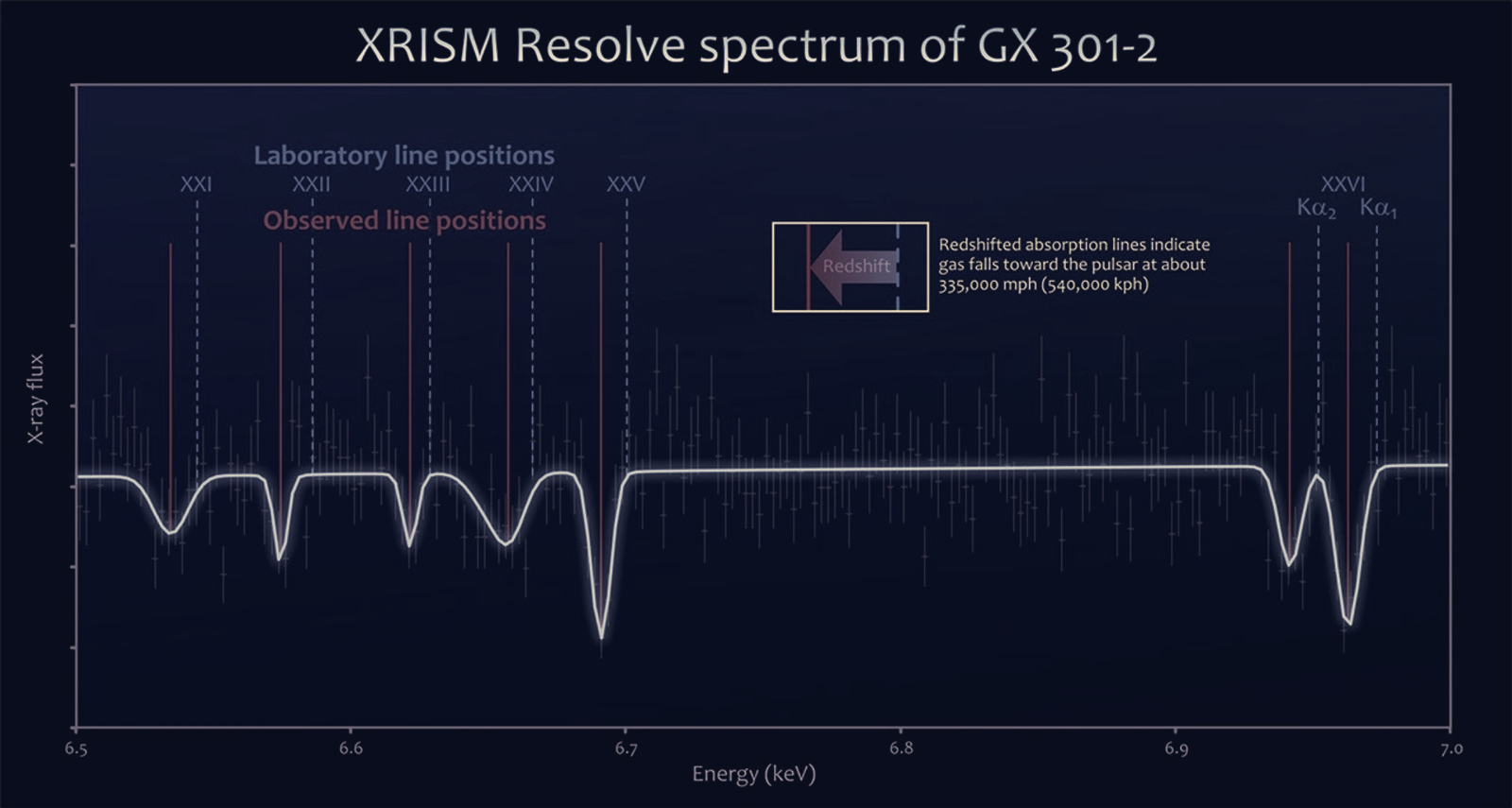
A pulsar has been seen gathering the outflow, or "wind", from its giant companion in X-rays, researchers report using data from the Japan-led XRISM X-ray Imaging and Spectroscopy Mission. The observation gives astronomers a direct look at a compact object intercepting material from its partner, rather than inferring that interaction indirectly.
XRISM, described by its name as an X-ray imaging and spectroscopy observatory and developed under Japan’s leadership with NASA and JAXA involvement, provided the measurements that identified the companion star’s outflow in X-ray wavelengths. That detection confirms the mission’s ability to both image the high-energy environment around compact binaries and to use spectroscopic information to characterise the emitting material.
Seeing a pulsar capture a companion’s wind in X-rays matters because it makes the interaction observable on the same energetic scale where the compact object releases most of its power. A direct X-ray view permits targeted study of how incoming stellar material is processed near the pulsar, and how that process produces X-ray emission. For systems where wind capture dominates mass transfer, such observations narrow the gap between theoretical models and measurable signatures.
The result positions XRISM as a tool for detailed follow-up on interacting binaries that include neutron stars and other compact objects. With the mission’s spectroscopic capabilities, researchers can now pursue comparative studies across systems to map how stellar wind properties and compact-object behaviour combine to shape high-energy emission. Those follow-ups will determine how common wind capture is among X-ray binaries and how it affects their observable characteristics.