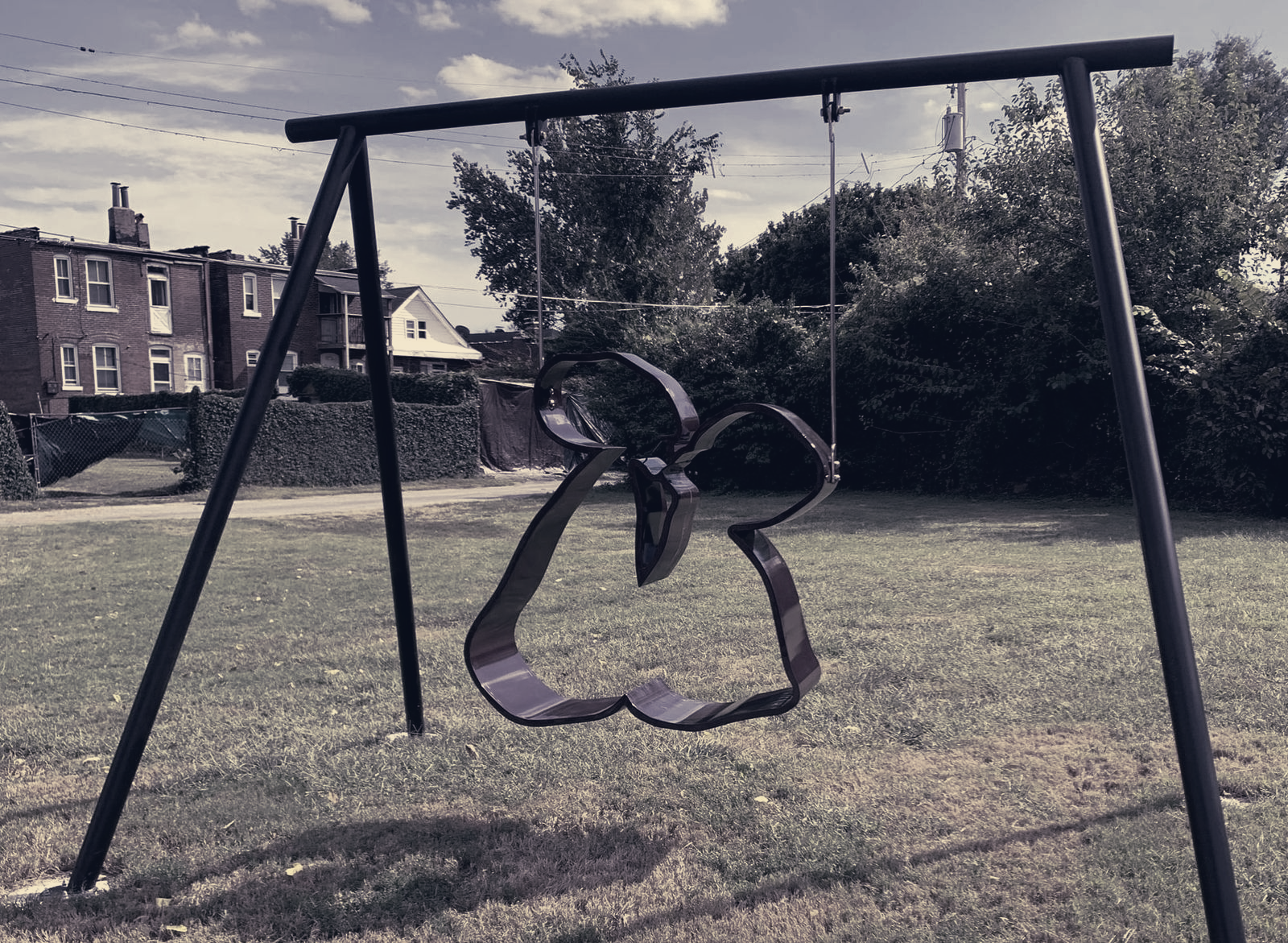
St. Louis gains a more visible public-art presence as the third Counterpublic Triennial unfolds across the city, delivering site-specific commissions that move art into streets, plazas, and civic thresholds. The exhibition stakes a claim on the idea that public works can shift local attention and reframe how residents and visitors encounter the city.
Reviewer Eileen G'Sell frames the triennial around risk and momentum, opening her account with a line that captures the show’s mood: "Suspended mid-leap with nothing below, the future lies outside of the frame." That image anchors Alice Bucknell’s commissioned piece Coyote Time, which takes its cue from a video-game moment when a character jumps off a cliff and is launched into midair. Bucknell’s work, and the other expansive public interventions gathered for this edition, ask viewers to choose between advancing into the unfamiliar or pausing to look back, a tension G'Sell reads as especially resonant in a city described as both frozen in time and ripe for renewal.
The Counterpublic Triennial’s third edition is presented as a sweeping celebration of public projects rather than a conventional gallery survey. Its programming deliberately leans on outdoor and civic sites, making art unavoidable in daily circulation and testing whether temporary commissions can seed longer-term cultural investment. That approach positions the festival as a laboratory for how contemporary work functions outside museum walls.
The triennial also arrives amid a crowded fall season of exhibitions and fairs elsewhere, with new guides for Chicago, Tribeca, and New York’s Armory Week mapping a parallel gallery-driven calendar. In New York, an evening of studio visits and artist conversations on September 30 at the International Studio & Curatorial Program will feature Alicia Grullón, Zoë Pulley, Erick Hernandez, Kara Springer, and others, underscoring how institutional programming and public commissions now run on overlapping tracks.
What follows for St. Louis will depend on whether the visibility created by Counterpublic translates into institutional support or sustained civic engagement. If the city embraces more of these site-based commissions, the triennial could become a durable engine for rethinking public space and bringing contemporary art into everyday urban life.