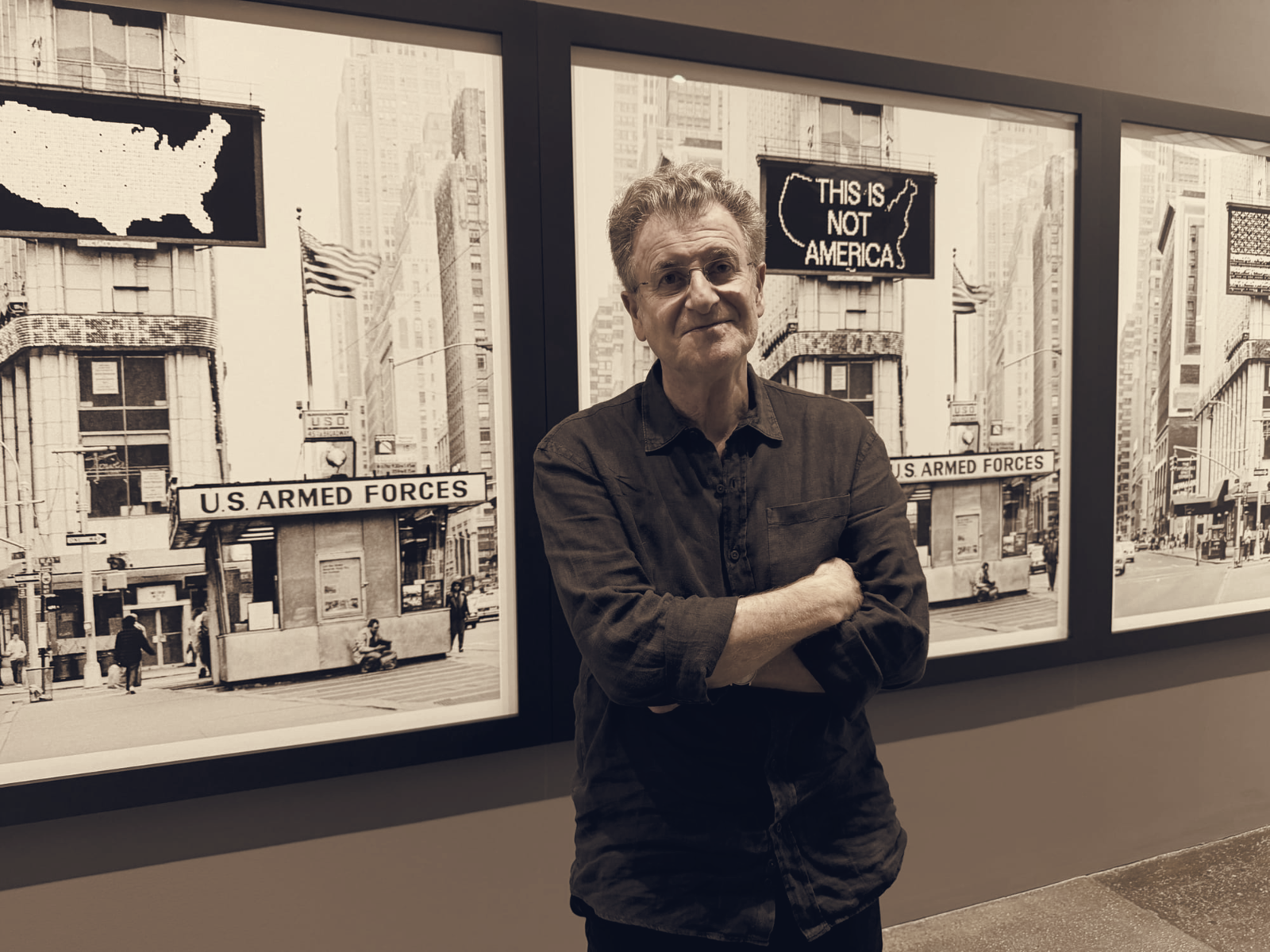
New York visitors gain a blunt public reminder that 'America' names a continent, not a single nation, as Alfredo Jaar restages A Logo for America at Galerie Lelong in Manhattan. The 1987 billboard animation, first shown amid the commercial onslaught of Times Square, returns in a gallery context that also gathers related works and Jaar’s original sketches.
The original installation condensed its challenging idea into a short LED loop that interrupted the language of advertising. Viewers first saw a map of the United States overlaid with the line "This Is Not America," followed by a flag with the text "This Is Not America’s Flag," and finally the letter R morphing into a map of North, Central, and South America. Jaar made the piece to contest the casual, US‑centric use of the word America, and its simplicity has let it accumulate new meanings as politics have shifted.
The work travelled internationally, briefly reappeared in Times Square for a minute at midnight in 2014, and was screened on a video barge off Miami Beach in 2016 in response to a presidential campaign’s attacks on immigrants. In the current show, Torres‑García’s 1943 work Inverted America sits among the references Jaar cites as inspiration, while a large video screen in the gallery recreates the sensory shock of late‑1980s Times Square for contemporary visitors.
Jaar frames his practice as rooted in public intervention. He says he left Pinochet’s Chile for New York in 1982, and that he began making street work as an architect intent on altering daily language and opening small democratic spaces under censorship. He describes himself as "a pessimist with my intellect and an optimist with my will," and allows that artists may not change the world but can demonstrate other possibilities.
Reinstalling A Logo for America amid anniversary politics that reuse the name America keeps the piece urgent, a reminder that contested language can be reclaimed and that a modest public artwork can continue to shape debate decades after its first appearance. The gallery run will let new audiences judge whether the 1987 intervention still shifts how Americans understand a word they often claim for themselves.