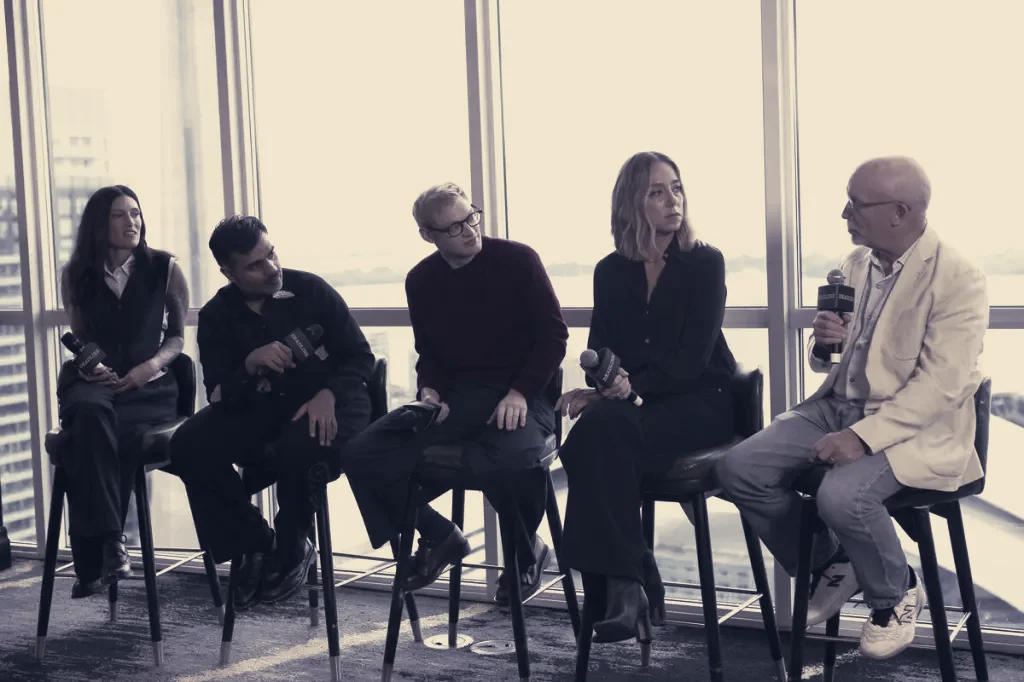
Compressed timetables, closed interviews and complicated logistics prompted a string of practical gambles from directors at a Deadline and Directors Guild of America panel in Toronto on September 12. Participants said those production constraints did more than cause headaches, they reshaped how finished films were shot and how those films will reach audiences.
The conversation at the Bisha Hotel included Curry Barker, Siân Heder, Alex Gibney, Rachel Morrison and Bassam Tariq. Barker, speaking on the one-year anniversary of Obsession, noted that commercial momentum did not relieve production pressure: Obsession premiered a year ago, was picked up by Focus Features and grossed more than $500,000 at the global box office. On his new Focus Features/Blumhouse Atomic Monster project Anything But Ghosts he described a punishing schedule, saying, "we had a 130-page script and we had 26 days to shoot it. I'm also starring in it and I'm directing and I'm the lead character. I have more lines than anyone in the movie." He said colleagues urged cuts—"Zach Kregger just told me, 'You have to cut 30 pages' and I probably should have listened to him. So, did my manager; he told me that, too"—but Barker kept the pages and filmed the whole script.
Documentarian Alex Gibney traced creative workaround to lack of access. "Nobody wanted to talk to me, either because they were terrified and the central subject didn't want to talk to me. In fact, as I asked [Musk] for an interview, he responded with a tweet. And the tweet was 'Gibney is a douche.' To which I responded 'Douché,'" he said. With traditional interviews closed off, Gibney described assembling existing audio and video and "production designed an avatar for the main interview where we had two angles: one looking direct to camera, one off to the side. Then as we edited the film and got it down to length, we then animated the character that we had created and it became the avatar." He also highlighted the limits of repetitive public statements, noting "He keeps repeating the same lines over and over and over again."
Bassam Tariq framed action filmmaking as a logistics problem compounded by time. His Mahershala Ali-starrer Your Mother Your Mother Your Mother was made on a 30-day production schedule that included five action set pieces, a setup he called a major uphill. Tariq also shared a creative maxim from his late editor-mentor Jonathan Oppenheim, "In the first five minutes of the film, you tell the audience how to watch the movie." The film debuts in cinemas on September 25.
Rachel Morrison said geography, not tone, was her chief constraint on Prime Video's Love of Your Life, which stars Margaret Qualley, Aaron Pierre, Gabriel Basso and Patrick Schwarzenegger. "My line producer would say that the greatest challenge was shooting in three countries, four cities, different states, which doesn't happen anymore at the studio level. There's a real tendency to pick a tax incentive state, shoot some plates and everything against green screen. I really wanted to shoot things on the ground," she said. The production filmed in London, Portugal, New Orleans and Boston, and the film streams on Oct. 14.
For CODA Oscar winner Siân Heder, the main production work was procedural: "trying to create an accessible set, which was a crazy journey because it hadn't been done before," she said, describing efforts to make production itself reflect the film's subject and principles.
Across the session the same pattern emerged: whether constrained by time, access, geography or inclusion, directors translated limits into formal choices. Several projects discussed carry firm release windows, and the filmmakers left the room framing those logistical limits as deliberate creative decisions that determine how audiences will experience their work, not merely as production problems to be papered over.