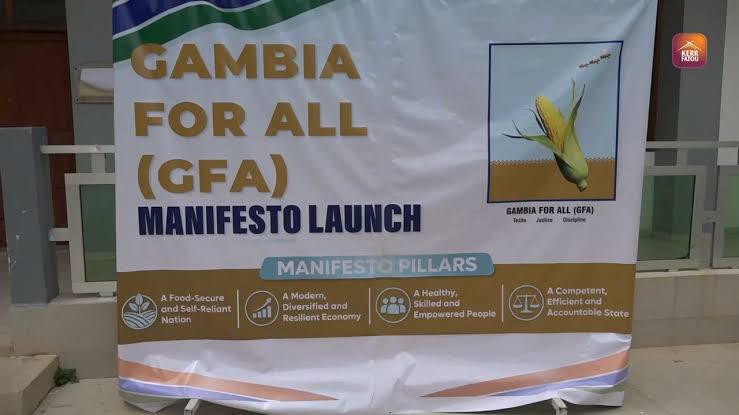
Gambians risk continued economic and social instability if the country's governance and economic challenges are not addressed, a situation that Gambia for All (GFA) hopes to change with its newly launched manifesto.
The party, founded by Bakary B. Darboe, a former minister of finance and former vice-president of The Gambia, presented a four-pillar programme focused on food security, economic transformation, human capital development, and system transformation.
This launch comes less than six months before the December 2026 presidential election, a critical moment for the country's political development.
Darboe, who also serves as the party's Secretary-General and leader, emphasized the importance of inclusivity and collective effort in building a better future for Gambians.
He stated that GFA was founded on the conviction that Gambians could work together to bring about transformative change, and that the party's philosophy is centered on confidence in the Gambian people and their ability to make a difference.
Darboe condemned parochialism and sectarianism, and instead advocated for a progressive modern state with a functioning participatory democracy and effective management of public affairs.
The GFA leader argued that the expectations created by the2016 political transition had not been fully met, and that the country needed a government focused on improving living conditions, maintaining good relations with neighboring countries, and enhancing The Gambia's international standing.
He expressed concern about declining standards of governance, insecurity, and worsening living conditions, describing The Gambia as "an extremely fragile state" affected by mediocrity, underperformance, and a lack of sensitivity to citizens' concerns.
Darboe envisioned a nation where citizens' rights are protected by law, and where individuals can live in peace and freedom within a caring community.
He presented the party's manifesto as a "sacred social contract" and a "roadmap to a wealthier, fairer, and more secured nation". The manifesto identifies four main pillars, with food security being one of the most urgent challenges facing the country.
According to data from the Gambia Bureau of Statistics, one in three Gambian households is considered food insecure, and about 90% of the rice consumed in The Gambia is imported.
With the presidential election approaching, Darboe urged Gambians to reflect seriously on the challenges facing their country and the policy changes needed to overcome them.
He described the moment as a "defining crossroads" for the nation, and presented the GFA manifesto as an alternative to the empty promises and political division that have characterized the country's politics for too long.
As Gambians prepare to go to the polls, the question remains whether the GFA's vision for a better future will resonate with voters and bring about the change that the country so desperately needs.