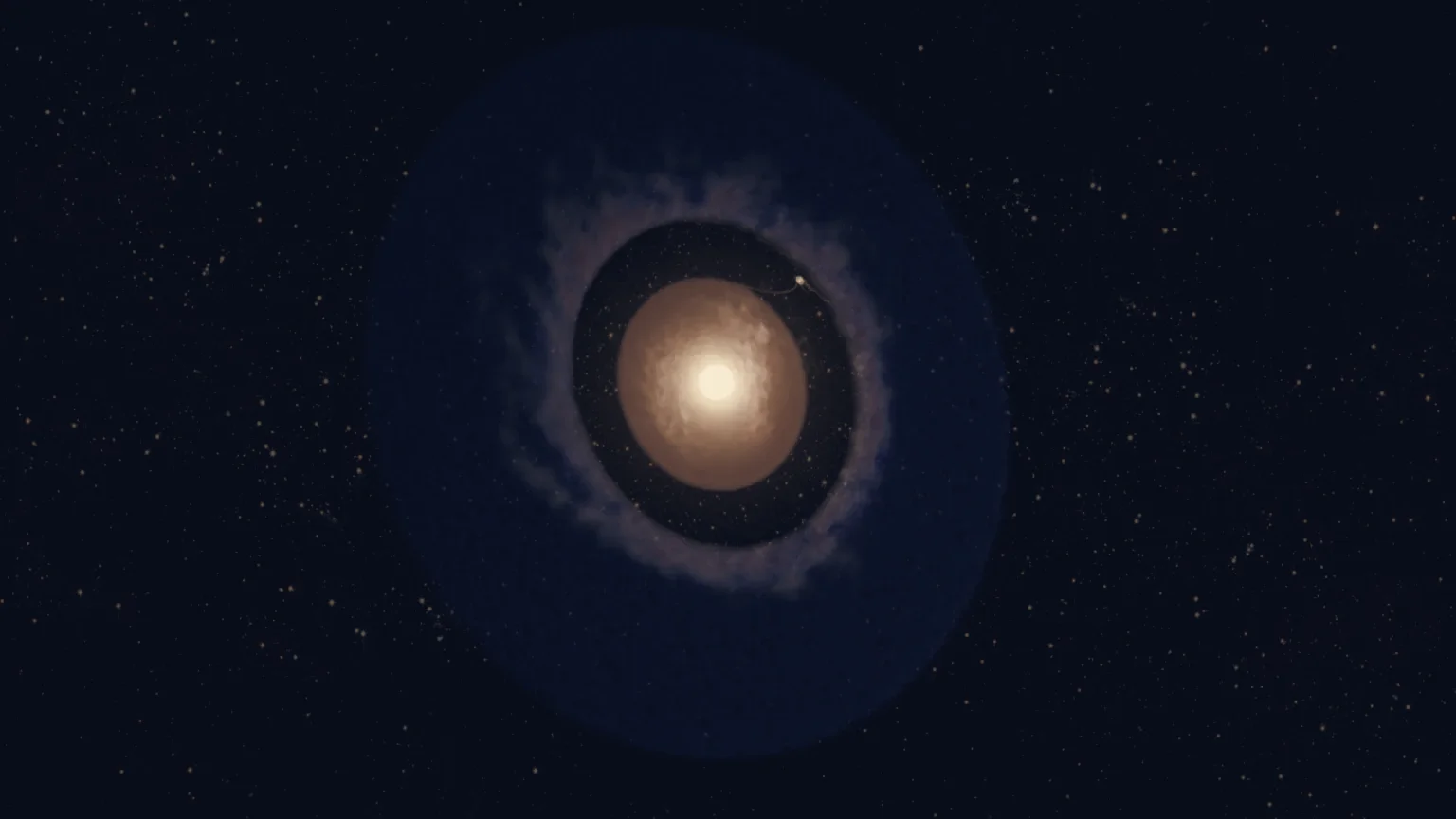
Planet-formation theory is at risk of revision after astronomers confirmed Elias 2-24 b as the youngest known planet, less than one million years old. The Jupiter-mass world was identified inside a prominent gap in the dusty disk around its host star, offering direct evidence of a giant planet still accreting material and calling into question models that predict much longer formation timescales.
The confirmation appears in a paper published in The Astrophysical Journal Letters and was led by Andrea Bernardi, a doctoral candidate at the Universidad Diego Portales in Chile. Bernardi’s team re-examined archival coronagraph images from the W. M. Keck Observatory that targeted seven young stars with structured debris disks. The Keck data, part of the NASA-funded Keck Observatory Archive, revealed the same faint point of light that earlier ALMA and Very Large Telescope observations had flagged in a disk gap, and tracking the source across observations from 2018 and 2020 showed motion consistent with an orbiting planet.
The planet orbits the star Elias 2-24 about 450 light-years from Earth at a distance roughly 55 times the Earth, Sun separation, and its mass is similar to Jupiter’s. Bernardi said, “The planets should be found within the gaps, since they are carving them. And that’s exactly where we found Elias 2-24 b.” That placement and the evidence of active accretion onto the planet support the idea that giant planets can form while still embedded in their natal disks.
Researchers note the finding conflicts with standard model expectations. Current theories generally require about 5 million years to assemble a Jupiter-size planet at Jupiter’s orbital distance, and even longer farther out, yet Elias 2-24 b lies far from its star and already shows planet-like behaviour. Lucas Cieza, a co-author, said the discovery shows existing models are missing important processes and that the field remains largely blind to these earliest stages with present telescopes.
The team highlights that combining observations from multiple facilities and archives made the confirmation possible, and Bernardi added that upcoming instruments such as NASA’s Nancy Grace Roman Space Telescope should make detecting similarly young planets easier. Continued searches for baby planets like Elias 2-24 b will provide the data needed to revise formation timelines and test which physical processes are absent from current simulations.