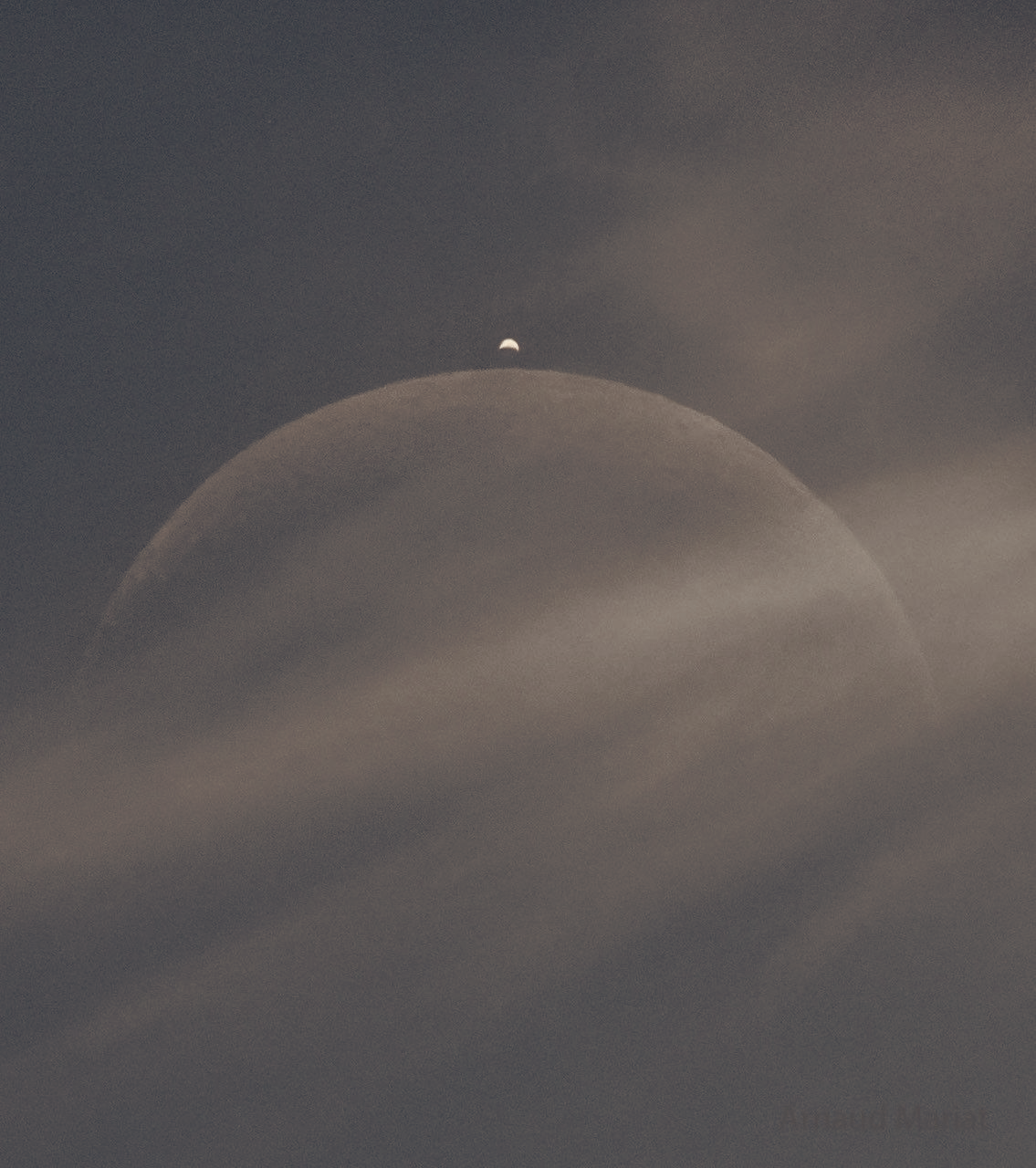
Skywatchers over Cessy, France gained a rare daytime view when the Moon moved in front of Venus around noon on September 15, 2026. The event produced a brief occultation observable from only a small fraction of Earth, and in this case most of the visible area was in daylight.
Photographer Arnaud Mariat recorded the moment in a single exposure that clearly shows both bodies appearing as crescents. The lunar crescent was very slim, with about 10 percent of the Moon’s face sunlit. Venus presented a fuller crescent, about 25 percent illuminated, and appeared brighter in the frame because it sits closer to the Sun and because its cloud cover reflects more sunlight than the Moon’s dark surface.
An occultation of Venus by the Moon is visible to roughly 10 percent of Earth’s surface when it occurs. Observers who were within that narrow track had the chance to see the planet disappear and reappear against the daytime sky. The photograph from Cessy captures the unusual contrast of a faint lunar sliver and a comparatively luminous planetary crescent in broad daylight.
The image and its explanatory notes are part of the Astronomy Picture of the Day archive. Credit for the photograph and release is given to Arnaud Mariat, and the APOD entry lists Robert Nemiroff, Jerry Bonnell, Cecilia Chirenti, and Keighley Rockcliffe among the authors and editors associated with the post. The APOD service also notes that its main site is moving from apod.nasa.gov to science.nasa.gov/apod.
Tomorrow’s APOD entry is listed as “galactic eye,” continuing the archive’s daily sequence of space imagery and short expert explanations. For readers and amateur astronomers, the Cessy photograph is a compact reminder that predictable celestial alignments can produce striking daytime views when geometry and timing align.