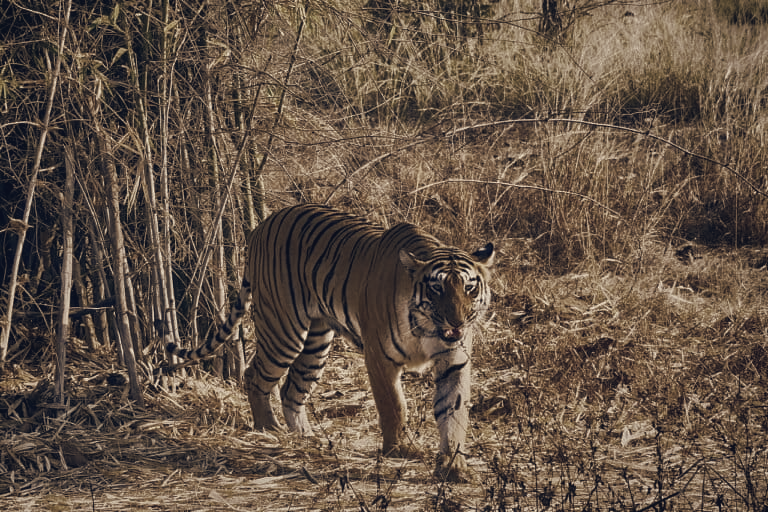
Kawal Tiger Reserve is losing the chance to host a breeding tiger population because linear infrastructure and industrial development fragment the dispersal corridor that links tiger populations to the west and east.
The reserve supports abundant prey species, including spotted and sambar deer, nilgai antelopes, and wild pigs, yet it lacks resident tigers. Since 2015 researchers have confirmed only 15 tigers moved into Kawal from Maharashtra, and of those just two were females.
Lead researcher Imran Siddiqui says tigers attempting the west, east movement face multiple barriers along the route. He listed open-cast coal mines, the Ada irrigation project, electrified farm fences, and the Hyderabad-Nagpur railway as major impediments, and identified National Highway 44 as the most difficult obstacle because of its heavy traffic and high fencing.
Siddiqui explains the consequence for population recovery is behavioural. Male dispersers tend to be, "bolder risk-takers," and will sometimes navigate human-dominated landscapes to reach Kawal. Females, however, "require quiet, undisturbed habitat to raise cubs," he said, and so are far less likely to cross routes that feel unsafe. "Crossing busy highways, railways, and mines poses a massive perceived threat to females," Siddiqui added.
The combined effect of these barriers is not a single hard border but a mosaic of risks that repeatedly stops dispersing tigers and sends them back before they can settle. Without more female immigrants, researchers say a self-sustaining, breeding population cannot take hold in Kawal despite the reserve’s suitable prey base.
That dynamic leaves Kawal functionally isolated: it can receive transient males but not the number of breeding females required to establish residency. The pattern highlights how connectivity, not just habitat quality, determines whether protected areas become true tiger strongholds.