
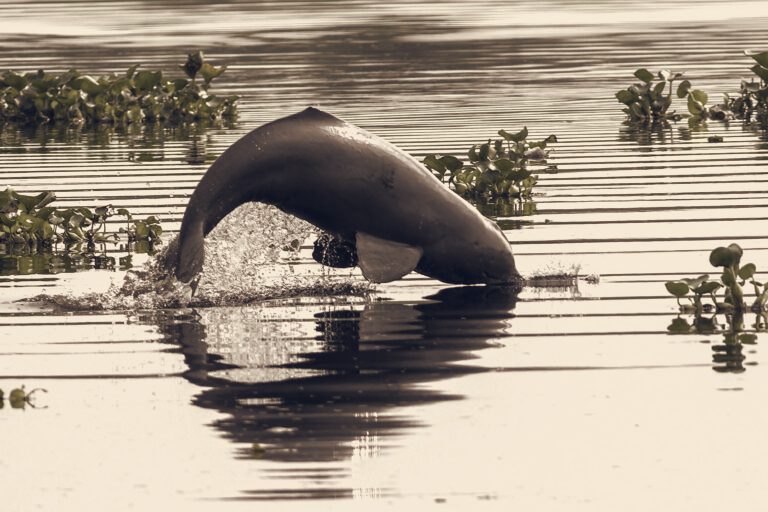
A small group of roughly 20 endangered Ganges river dolphins survives along a degraded 27‑kilometre reach of the Buriganga, a remnant that researchers say forces a rethink of local conservation priorities. Scientists carried out monthly counts from September 2023 through August 2024 and published their findings in the Journal of Asia-Pacific Biodiversity, systematically covering the 27‑km segment that skirts Dhaka’s southern edge within the river’s 29‑km course.
The team estimated about 20 individuals in total, with average group size at 4.18 animals, a mean the authors flag as larger than in earlier surveys. Sightings were not constant: detections peaked in December and across winter months, while none were recorded in October 2023 or during July and August 2024. That seasonal pattern points to temporal variation in presence or detectability rather than steady numbers across the year.
The persistence of dolphins comes despite severe pollution and a near collapse of native prey. The surveyed stretch receives untreated sewage and solid waste, ongoing tannery discharges and other toxic industrial effluent from hundreds of factories, leaving much of the waterway degraded. Native fish species have effectively vanished from the study area, and an invasive suckermouth catfish, Hypostomus Plecostomus, locally called sakar fish, now dominates portions of the river.
Md. Aminur Rahman, one of the study’s researchers, said, "The Buriganga is not a usual place for dolphins, where native fishes have largely vanished. Leaving the river full of invasive suckermouth catfish [Hypostomus Plecostomus, locally called sakar fish]. When we found [the dolphins], we were amazed at how it was possible. Because the river is not livable for fish. Around the year, we didn’t track any dolphins only during two of the months, but all the other 10 months we tracked them."
The study frames the Buriganga dolphins as a small, potentially vulnerable remnant, creating a conservation paradox: an endangered freshwater cetacean persisting where its prey base has largely collapsed. By documenting seasonal patterns, group sizes and a baseline population estimate, the research supplies a starting point for future monitoring and any conservation measures aimed at the Dhaka region’s riverine wildlife.