
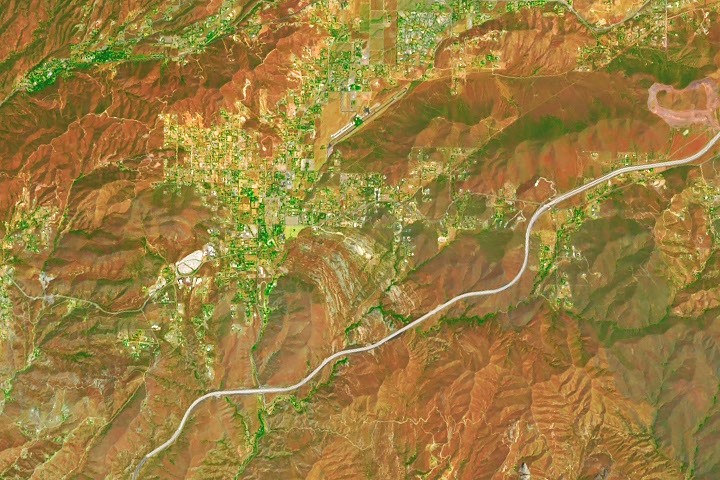

The steeply tilted layers of sedimentary rock at Vasquez Rocks, visible in recent Landsat 9 imagery, are the feature that draws film and television crews to the site. Images published by NASA’s Earth Observatory show rock strata rising from the Soledad Basin at striking angles, a look producers have long used to signal alien or otherworldly terrain.
NASA highlighted the scene as its Image of the Day for Sep 7, 2026. The views, captured by the Operational Land Imager on Landsat 9, include both natural-color and false-color renderings that emphasize the patterns and contrasts in the outcrops. The Earth Observatory tagged the item with topics including Human Dimensions and Topography, underscoring the crossover between geological form and cultural use.
Those tilted beds have attracted location scouts and cinematographers for decades. The article notes that television and film producers, including the team behind Star Trek, have repeatedly chosen Vasquez Rocks for its dramatic, non-terrestrial look. The satellite imagery makes those same visual cues visible from orbit, recording the angles and textures that make the site visually distinctive.
Beyond studio decisions, the Landsat 9 photos serve as a durable record of the landscape’s appearance in both natural and enhanced palettes. By documenting the site from space, the images preserve how the outcrops present across seasons and lighting conditions and provide data layers useful for topographic study. NASA’s public presentation of the images ties a scientific sensor to a cultural story: a geological formation that moves between research, recreation and entertainment.
The Earth Observatory presentation keeps the feature visible to scientists, land managers and the public, and the Landsat 9 archive ensures the Vasquez Rocks scene remains available for future comparison and cultural reference.