
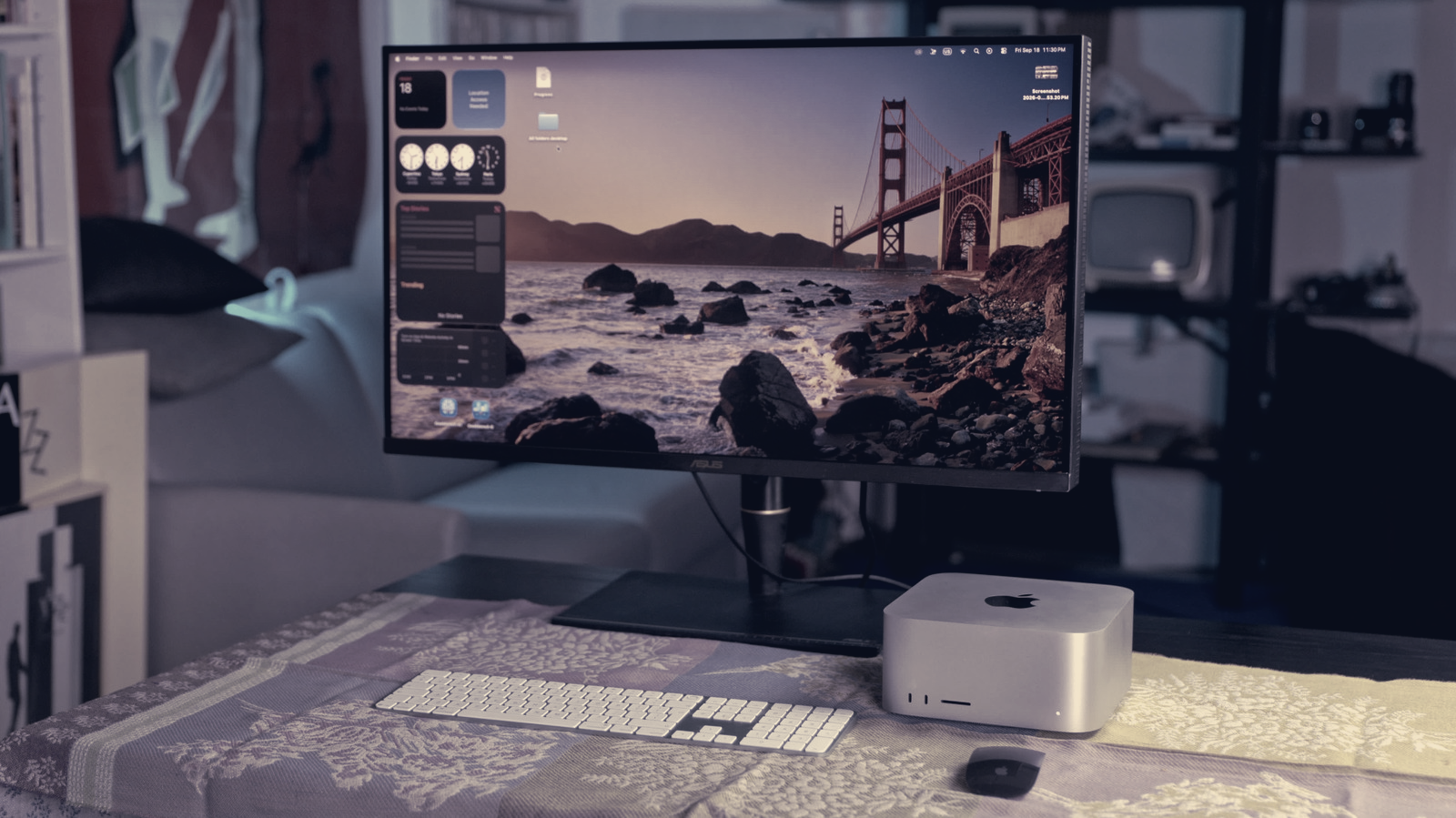
Most buyers now pay materially more for Apple’s fastest desktop, while creative and AI professionals gain a compact machine that meaningfully shortens heavy workloads. The Mac Studio equipped with the new M5 Ultra pushes single- and multi-core compute, GPU rendering and neural tasks beyond previous Studio models, but starts at $5,500 and climbs steeply: my review unit, with a 36-core CPU, 256GB of unified memory and 2TB of storage, listed at $11,299.
The enclosure and port layout are unchanged, keeping the same 3.7-inch tall, 7.7-inch square footprint that fits neatly on a desk and can be stacked. The M5 Ultra model adds two high-speed Thunderbolt 5 USB-C ports on the front, while the M5 Max has two slower USB-C 10 Mbps ports there. Around back both versions provide four Thunderbolt 5 USB-C ports, two USB-A ports rated up to 5Gb/s, an HDMI 2.1 output, 10Gb Ethernet and a 3.5 mm headphone jack. The Thunderbolt 5 ports are capable of up to 120 Gbps, though compatible accessories that exploit those rates remain expensive.
Internally the M5 Ultra pairs as many as a 36-core CPU with an 80-core GPU and a 32-core neural engine, up from 32 CPU cores in the prior Ultra. Unified memory is offered in 96GB and 256GB today, with a 512GB option arriving next month. Apple removed its earlier claim that the Studio used PCIe 6.0, and the machine’s sustained disk throughput reflects what the reviewer calls the upper limit of PCIe 5.0, with measured write speeds around 14GB/s and read speeds near 11GB/s.
Benchmarks show the kind of gap that will matter to studio and AI workloads: a multi-core Geekbench 7 run returned 52,185 on the M5 Ultra versus 39,145 on the prior M3 Ultra. Overall CPU, GPU and neural scores sit roughly 20 to 30 percent ahead of the M3 Ultra in synthetic tests, while AI-oriented synthetic tests were closer to a 10 percent advantage over the M5 Max. In real-world editing work the Studio made a nine-minute 4K timeline export in 1 minute 13 seconds, compared with more than eight minutes on a MacBook with an M3 Pro, and it handled multiple high-resolution ProRes and RAW tracks smoothly.
Those performance wins come at a price. The new M5 Ultra base price rose to $5,500 from the previous $4,000, and the top test configuration is far more costly than the M5 Max alternatives; a high-end M5 Max option with 2TB of storage was $5,899, and the last top-end M3 Ultra configuration cited cost $7,499. Apple’s earlier bump to M5 Max base pricing, and what the reviewer calls the current "RAMageddon" in memory costs, are big drivers of the higher Street prices.
For professionals whose workflows depend on the fastest possible CPU, GPU and neural throughput, the Mac Studio M5 Ultra delivers measurable time savings. For most buyers the price premium will be hard to justify, and those considering the highest memory tiers should note 512GB availability is scheduled next month, which may be decisive for large-scale AI or media projects.