
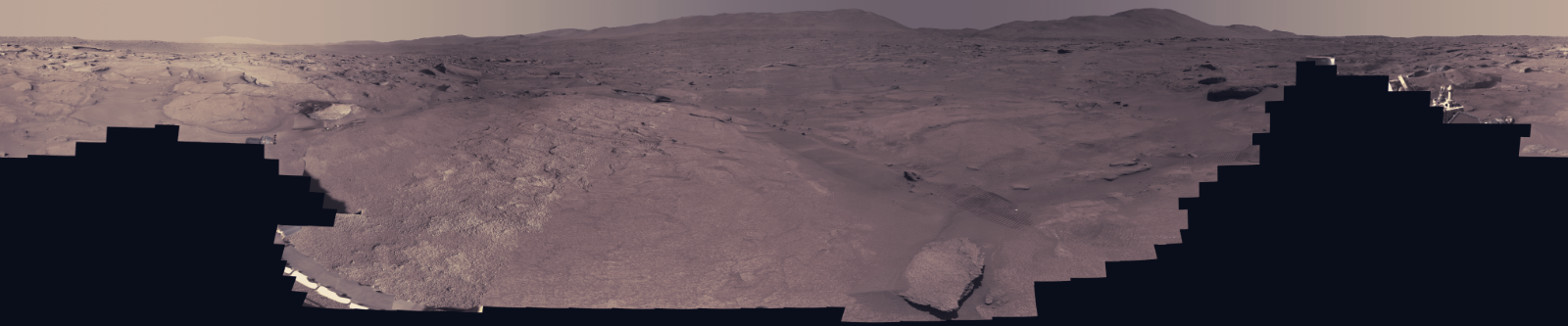
Scientists must revise how they interpret Jezero Crater’s carbonate exposures and past habitability after NASA’s Perseverance rover found igneous bedrock in the crater’s Margin Unit that records at least three separate interactions with water.
When the rover reached the inner rim of Jezero in September 2023, mission teams expected layered sedimentary deposits typical of an ancient lake shoreline. Instead, SuperCam and other instruments identified coarse-grained, olivine-bearing igneous rock at higher elevations, indicating slow cooling of magma deep underground. Lower down, rocks show pervasive alteration: fractured olivine with silica and carbonate filling cracks, and, in one eastern site, a roughly 10 inches (25 centimeters) thick mineral vein composed of calcium sulfate and fluorite.
Those minerals map a sequence of aqueous episodes rather than a single lacustrine alteration. The first event involved carbon-dioxide-rich groundwater reacting with olivine to produce carbonate ridges preserved along fractures. A second episode likely involved lake waters, leaving behind additional silica where olivine transformed into carbonate. The final event produced mineral veins that include fluorite, a mineral that typically signals hot water moving through volcanic rocks, pointing to a later heated underground fluid pulse.
Perseverance collected the data used in this analysis between Oct. 8 and Oct. 16, 2023, and the team analyzed more than 185 bedrock targets with SuperCam’s laser spectroscopy, which can probe targets up to 21 feet (6.5 meters) away. The rover traversed roughly 870 feet (265 meters) of vertical relief within the Margin Unit while building the mineralogical record reported Monday in the journal Communications Earth & Environment.
The finding reframes the origin of the carbonate signature seen from orbit across one of Mars’s largest carbonate exposures. Researchers say the Margin Unit acted as a junction for multiple aqueous systems rather than simply recording a shoreline deposit, a conclusion that carries implications for assessing past habitability because reactions between olivine and water can release hydrogen and produce carbonate and silica, minerals that can preserve biosignatures.
Perseverance’s mission includes astrobiology goals, characterizing geology and past climate, and collecting and storing rock and regolith for later study. The rover is managed by JPL, which built and operates the vehicle for NASA’s Science Mission Directorate. SuperCam is co-led by Purdue University, Los Alamos National Laboratory, and IRAP.
The team says the Margin Unit results should change how scientists read Jezero’s history and inform broader interpretations of carbonate-bearing regions on Mars, helping reconstruct the planet’s changing climate and its potential to have supported life in the past.