Buyers now pay more for a faster Mac mini. Apple’s 2026 Mac mini starts at $899 with 16GB of RAM and 256GB of storage, a $300 jump from the $599 M4 model sold in 2024. The new M6 chip brings measurable CPU gains, but that price increase undercuts the Mac mini’s previous position as one of Apple’s best desktop bargains.
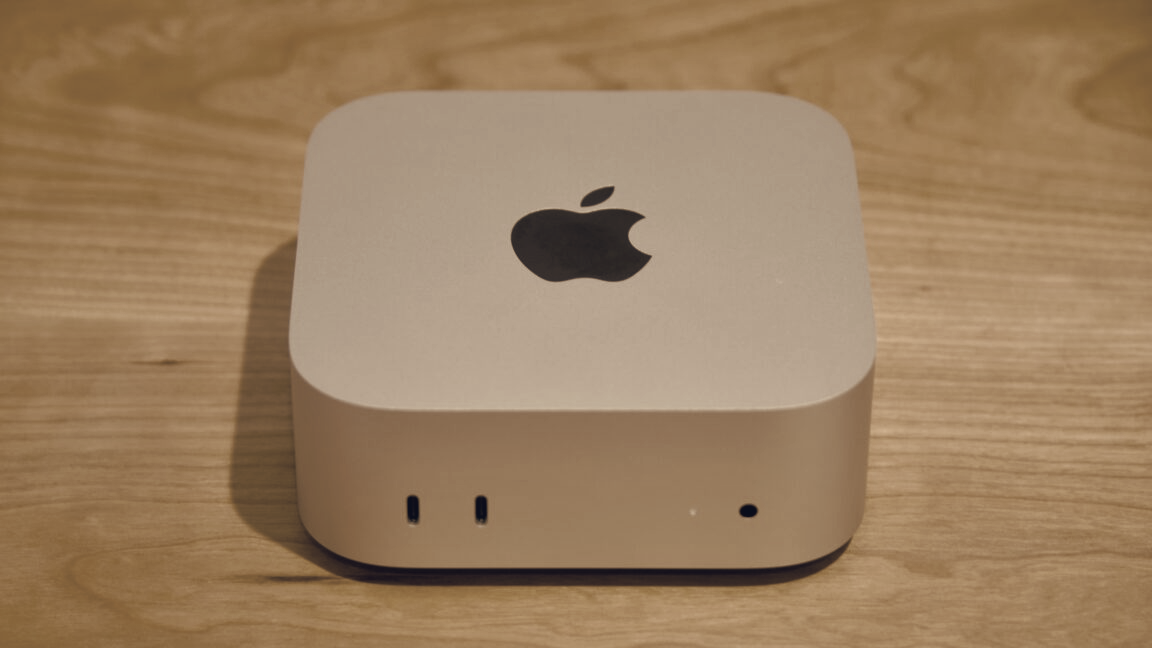
Externally the mini is unchanged from the M4-era redesign. The compact case is slightly taller at 2 inches, up from 1.4, while the footprint tightened to 5×5 inches from about 7.7 inches squared. The system remains actively cooled, with a bottom fan to keep sustained clock speeds high. Front I/O includes two 10 Gbps USB-C ports and a headphone jack; the rear offers HDMI, an Ethernet jack that is 2.5 Gbps by default or 10 Gbps as an option, and three Thunderbolt ports.
The M6 is Apple’s first chip to mix Super cores, regular performance cores, and efficiency cores in one package. Its CPU layout is two Super cores, four P-cores, and six E-cores, for a 12-core total. That contrasts with the M5 and M4, both 10-core designs, and the M1, M3 generations, which used four P-cores and four E-cores. Apple increased L2 cache on the higher-performance cluster to 20MB, up from 16MB in the M5’s Super cluster, and the E-core cluster’s L2 grew to 8MB from 6MB. Reported clock ranges for the P- and S-cores run from 1.44 GHz to 4.79 GHz.
Apple also adjusted memory bandwidth. The M6 supports up to three displays and offers 153GB/s bandwidth on 16GB machines and 170GB/s on 24GB or 32GB configurations. By comparison, the M5 sits at 153GB/s and the M4 at 120GB/s. GPU core counts follow the trend of the Apple lineup, with the M6 listing 12 GPU cores while earlier chips ranged down to eight in the first M1.
There are practical trade-offs. The M6 Mac mini uses Thunderbolt 4 ports, which top out at 40 Gbps. Machines with Thunderbolt 5, such as the M5 Pro model, support up to 120 Gbps, a difference that matters for daisy-chaining multiple systems or very high-bandwidth external devices. Apple still does not support external GPUs, and many users will never need the extra Thunderbolt headroom.
Minor design complaints persist. The power button stays on the bottom rear of the enclosure, a placement that rarely matters if the Mac sleeps, but it becomes awkward when pairing a Touch ID external keyboard, which requires a quick double-tap of the power button to activate the sensor. The review unit was the M6 Mac mini only; an M5 Pro Mac mini was not available for testing and will be discussed in the Mac Studio review.
Ultimately the M6 brings Apple’s latest low-end silicon advancements to the smallest desktop, but the wider market consequence is clear: amid a 2026 memory supply crunch Apple has raised the base price, and that shift reduces the Mac mini’s value proposition compared with the cheaper M4 alternative.