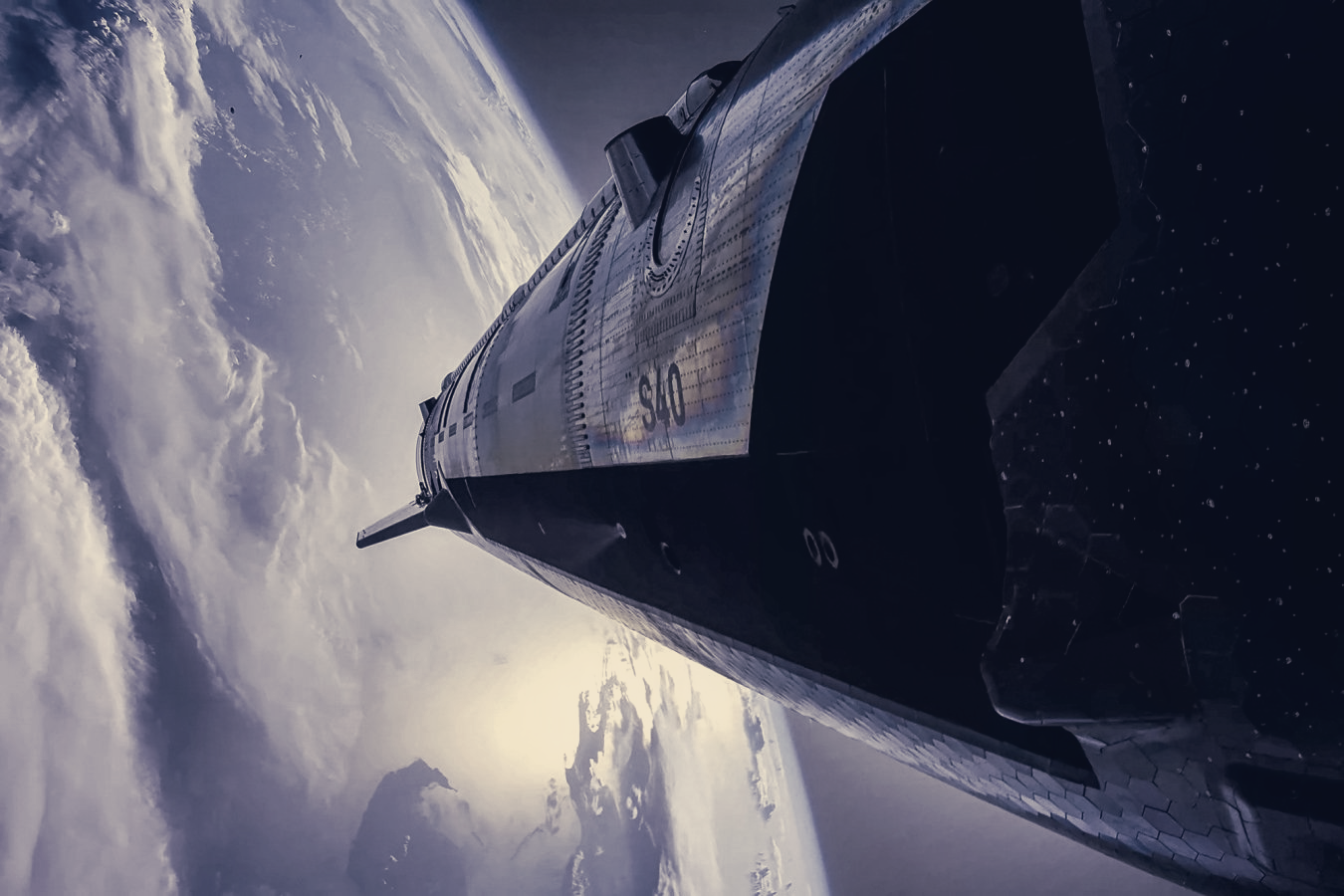
What happens on 22 September will decide whether Starship progresses from high-profile tests to a tool for routine satellite delivery. SpaceX has scheduled the vehicle’s first orbital flight from its Starbase site in Texas, with a launch window opening at 7.15am CDT, 1.15pm BST, on 22nd September. The company lists the mission as Starship’s 14th flight.
The Story in Pictures
The mission plan calls for the upper stage to climb to 275 kilometres and complete six orbits over roughly 10 hours, then re-enter and splash down in the Pacific Ocean to the west of Chile. Unlike earlier flights that carried test masses, this mission will carry 26 Starlink V3 satellites, the first operational spacecraft the system will attempt to deploy.
Starship is a two-part system, an upper stage also named Starship and a lower booster called Super Heavy. SpaceX is testing third-generation hardware for both sections through a rapid iteration approach, and all previous 13 flights reached at best sub-orbital trajectories. The company says on its website that “there have been several modifications to hardware and software to address issues seen on the previous flight.”
Three of the Starlink V3 payloads have been fitted with cameras to image the vehicle’s heat shield while in orbit and downlink those pictures to engineers. That imagery, together with telemetry, will feed directly into assessments of re-entry performance, a phase where the programme has faced problems in recent tests. On the 13th flight the booster completed ascent but suffered a hard splashdown after only eight of the 13 engines intended to slow its descent reignited.
Experts contacted for comment say the mission signals growing internal confidence but underline that re-entry is the crucial unknown. Davide Amato at Imperial College London said, “In short, they’re making good progress towards introducing Starship as a successful commercial launcher.” He added, “Whether Starship will be ‘revolutionary’, as promised by their CEO, will depend on whether they will be able to achieve a high launch cadence and on whether their design is cost-effective.”
Leah-Nani Alconcel at the University of Birmingham described the flight as a crucial step for Starship’s commercial role, noting the V3 hardware sits in a lower orbit and offers higher capacity than earlier models, and that its larger size tests Starship’s ability to lift substantial payloads. She said, “I don’t think it’s a huge jump in operational complexity for the launch vehicle, but demonstrating the Starlink V3 delivery to orbit is a significant step.” She added, “It may not be as flashy as the ‘ chopstick catch ‘ for the vehicle stages, but it would be a big boost to their commercial capabilities to have both the already-established high-cadence Falcon 9 and a proven Starship in their repertoire.”
SpaceX will not attempt controlled recoveries of either stage on this flight. The mission is the company’s third flight so far this year and the second since its flotation on the stock market that made Elon Musk the world’s first trillionaire. Engineers will monitor orbital insertion, satellite release and re-entry closely; success would move Starship closer to carrying operational payloads and joining Falcon 9 on a commercial footing, while failures would leave the programme in test mode and require further iterations.