
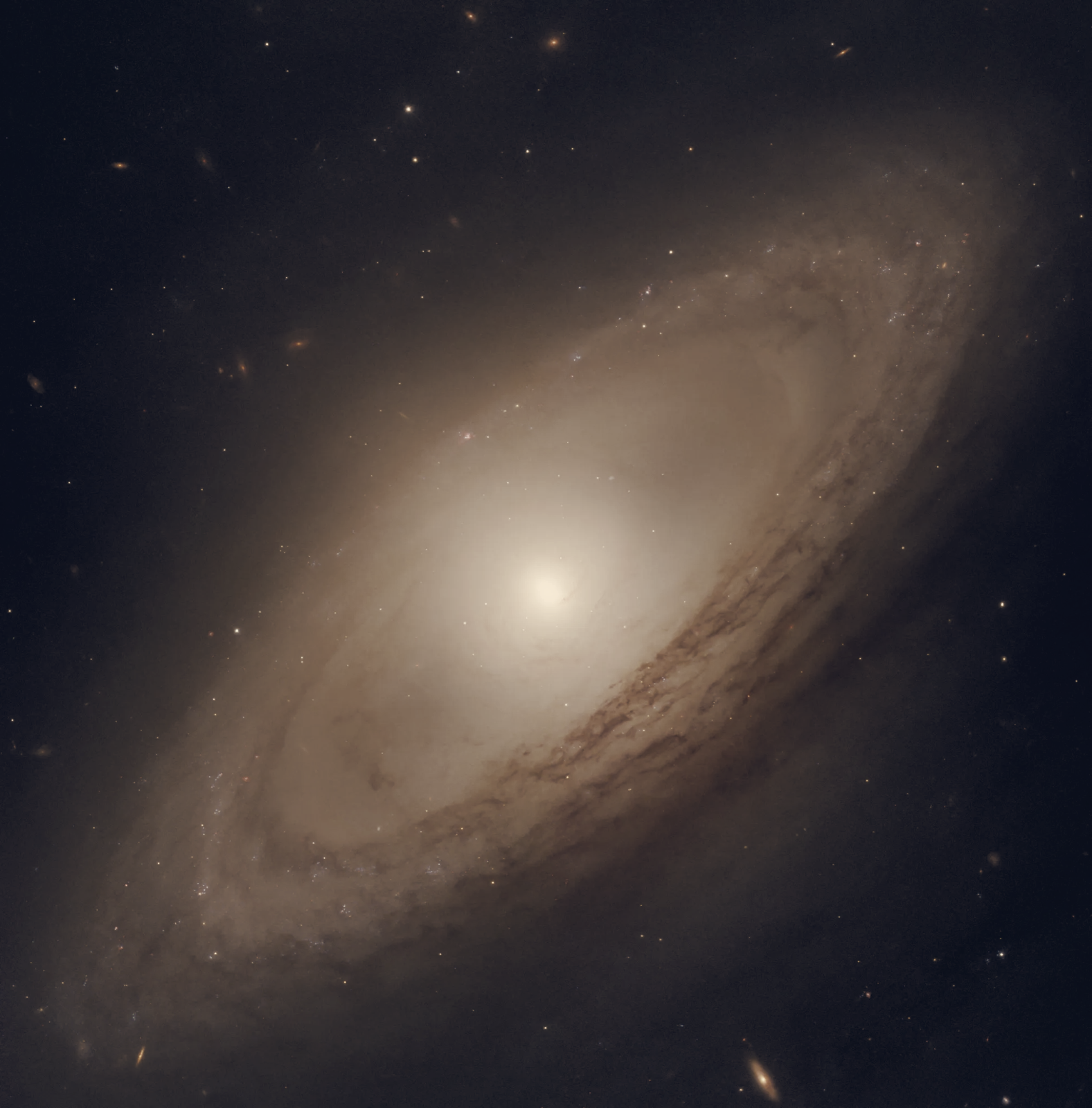
Hubble images reveal that the central bulge and the stars and gas closest to the centre of NGC 4698 rotate at right angles to the galaxy’s outer disk, suggesting the core built itself by acquiring material from outside. The galaxy lies about 55 million light-years away in the constellation Virgo, and it is one of over a thousand galaxies bound together in the Virgo Cluster.
At first glance NGC 4698 resembles a familiar spiral, with arms curling within a thin disk marked by brown dust lanes and clusters of bright blue stars. But unlike many spirals, NGC 4698’s spiral arms are prominent only in the outer disk; they fall away from the luminous centre and form a ring-like structure around the galaxy’s edge. The central region is dominated by an elongated bulge, a faint off-white glow produced by older, cooler stars packed tightly together.
That elongated bulge appears to extend out of the disk at roughly a right angle, and the inner gas and stars rotate perpendicular to the rest of the galaxy. Astronomers interpret this misalignment as the likely result of external accretion: material drawn in from outside the galaxy can settle into an inner disk or ring at an angle to the original plane. Some observations of NGC 4698 also show a short tail of hydrogen streaming from one side, a detail consistent with a past minor merger that could have supplied the off-angle gas.
The bulge’s stars orbit a supermassive black hole with a mass described as millions of times the Sun’s mass, and data show the black hole is actively growing by drawing gas inward. The new Hubble data come from an observing program targeting galaxies in the Virgo Cluster, a campaign that captures both fine details such as individual star clusters and nebulae and the broader context needed to understand how a galaxy’s passage through a cluster shapes its evolution and star-forming capability.
Researchers will use these observations to probe how interactions within the Virgo Cluster alter galaxy structure and fuel processes like central star formation and black hole growth. The perpendicular inner rotation in NGC 4698 offers a nearby example of how external gas supply and minor mergers can rearrange a galaxy’s central dynamics.