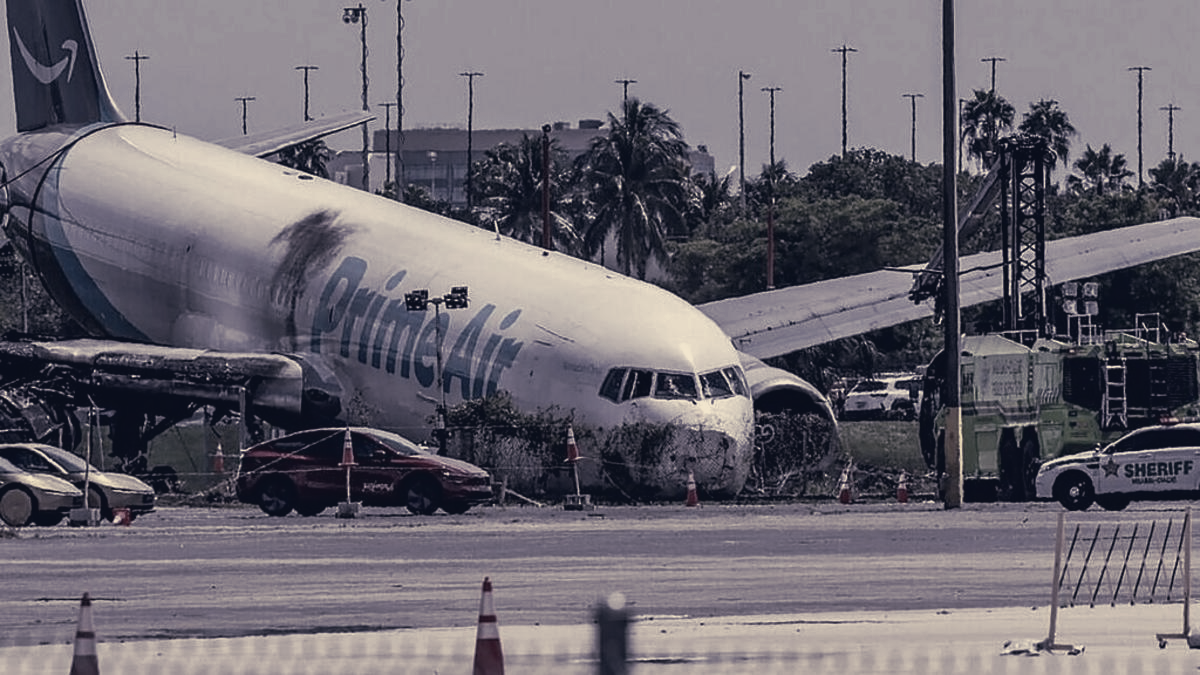
Five ground workers were killed and five others injured when Amazon Prime Air Flight 7598, a Boeing 767-300, overran a runway in Miami, struck vehicles and burst into flames, the US National Transportation Safety Board said as it published preliminary flight data. The NTSB disclosed recordings of cockpit exchanges, automatic callouts and the aircraft’s speed, altitude and flap settings in the final minutes before the accident.
The agency’s material shows one pilot warning a colleague several times about what he described as excessive speed, while the recording did not capture a consistent answer from the other crew member even as automated alerts sounded. Investigators logged an electronic sink-rate callout and a separate "too low terrain" alert shortly before the jet left the runway. The recorded landing speed was 158 knots, 292km/h, a figure experts have said sits at the high end for that stage of flight.
Flight data also indicates flaps were extended later in the approach than is typical, a detail aviation counsel Pablo Rojas flagged as worrying. Rojas told US media the released material "really confirms that this was, in a way, a doomed approach." He added, "The flap deployment here happened much later in the accident sequence," and suggested the delay "is maybe because the pilots were responding to the fact that they were going too fast."
After overrunning the runway the jet struck ground equipment, hit a white Ford van and then collided with a Toyota Corolla, coming to rest about 1,300ft, 394m beyond the runway. Miami authorities identified the five people killed in the van as Rolando Aleman Leon, 55; Yoel Rodriguez Naranjo, 53; Julio C Pineda, 75; Carlos Acosta Fajardo, 53; and Javierkys Reyes Quevedo, 47.
The NTSB is leading the formal investigation and has published the preliminary flight data as it seeks to determine why the approach became unstable and why cockpit warnings and automated alerts did not prevent the overrun. Investigators will continue analysing recorded systems data, crew communications and aircraft configuration to build the technical timeline that will guide the next phase of the probe.