
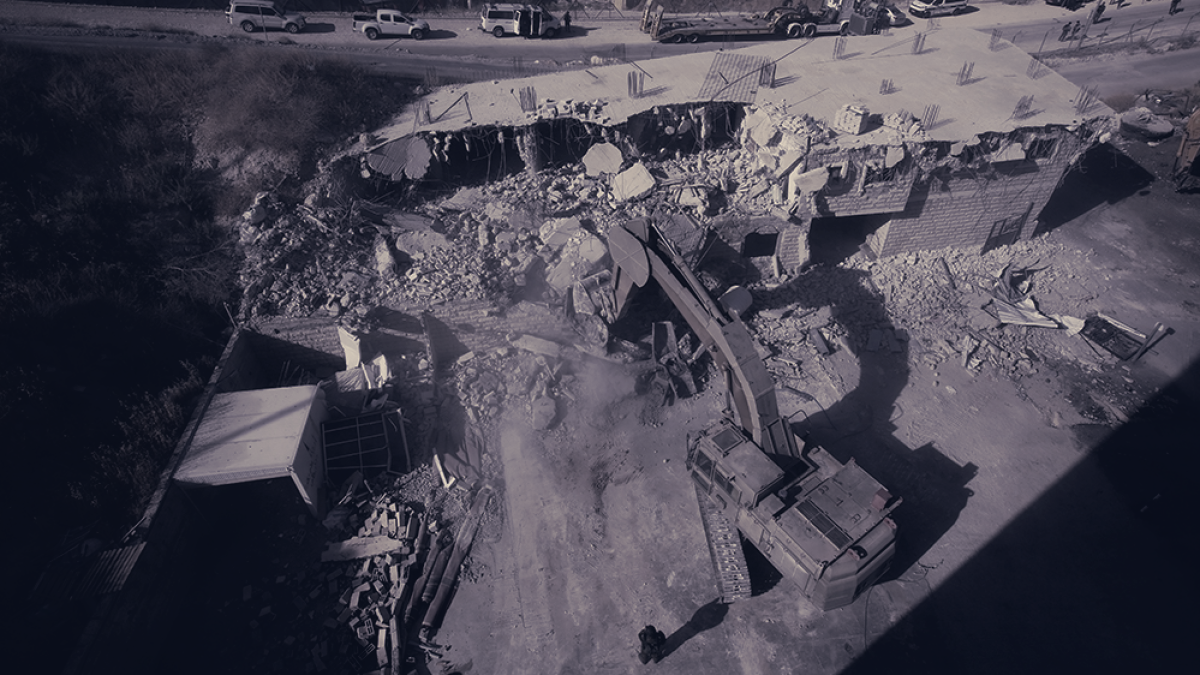
Palestinians across the West Bank and East Jerusalem now face a faster timetable for home demolitions after Israeli authorities began using advanced AI tools to scan territory and flag treated as unauthorised construction. Researchers and rights activists say Rafael’s ImiSight, tested previously in the Naqab desert, has been adapted for use in occupied areas where enforcement units already demolish structures on alleged building violations.
Rights groups and researchers report ImiSight surveyed more than 10,700 square kilometres in the Naqab and helped prompt the forced eviction of more than 2,600 Palestinian Bedouin citizens of Israel. Activists say the technical approach used there—automated scanning, prioritisation and routing of targets—has been transferred to West Bank operations, supported by an Israel Land Authority enforcement unit established in April 2025 specifically to work inside the territory.
The Israeli rights group Peace Now described that institutional move as a "step of annexation", and said the agency deploys "advanced technological tools, based on artificial intelligence, for detecting encroachments." Amir Daoud of the Colonisation and Wall Resistance Commission framed the change as a deliberate escalation, saying, "We are talking about transferring a surveillance and eviction model tested against Palestinians in the Naqab to the occupied Palestinian territory." He added, "The political danger begins with establishing a district affiliated with the Israel Land Authority to operate inside the West Bank. This means introducing an Israeli civilian government apparatus directly into an occupied territory."
Human-rights monitors report demolitions have climbed sharply since automated tools and expanded enforcement were introduced. Peace Now and Kerem Navot documented an 80 percent rise in demolitions in Area C and occupied East Jerusalem when comparing 2010–2022 with 2023–2025. Between 2023 and 2025, an average of 966 buildings were razed each year, and Israeli forces destroyed 1,288 Palestinian structures from January to September 2025 alone.
Technological shifts are speeding the workflow. Khaled Safi, a Palestinian digital media and technology expert, said, "When [powerful computer chips] and AI algorithms were adopted inside the satellite itself, it practically turned the satellite into an edge computing terminal operating in space." Activists warn that putting more of the sensing, analysis and prioritisation inside satellites and automated systems shortens the interval between detection, warning and demolition, increasing the risk of a human-out-of-the-loop approach to decisions that displace communities.
Ground-level intelligence strengthens that pipeline. In 2023 the government allocated 33 million shekels, about $9m, to settler patrols and 40 million shekels, about $13.2m, to equip outposts with drones and cameras, funding rights groups say has helped turn outposts into surveillance nodes that can feed automated systems. "The algorithm here is a 'force multiplier': It scans vast areas, prioritises targets, identifies recent changes and allows a faster transition to warning and demolition," Daoud said.
Rights groups and technologists warn that the combined effect of edge computing, AI analysis and expanded enforcement capacity will sustain higher demolition rates and faster displacement unless those policies and practices change. The next questions are whether legal or political checks will limit automated detection being used to accelerate demolitions, and how enforcement units will apply the new tools on the ground.