
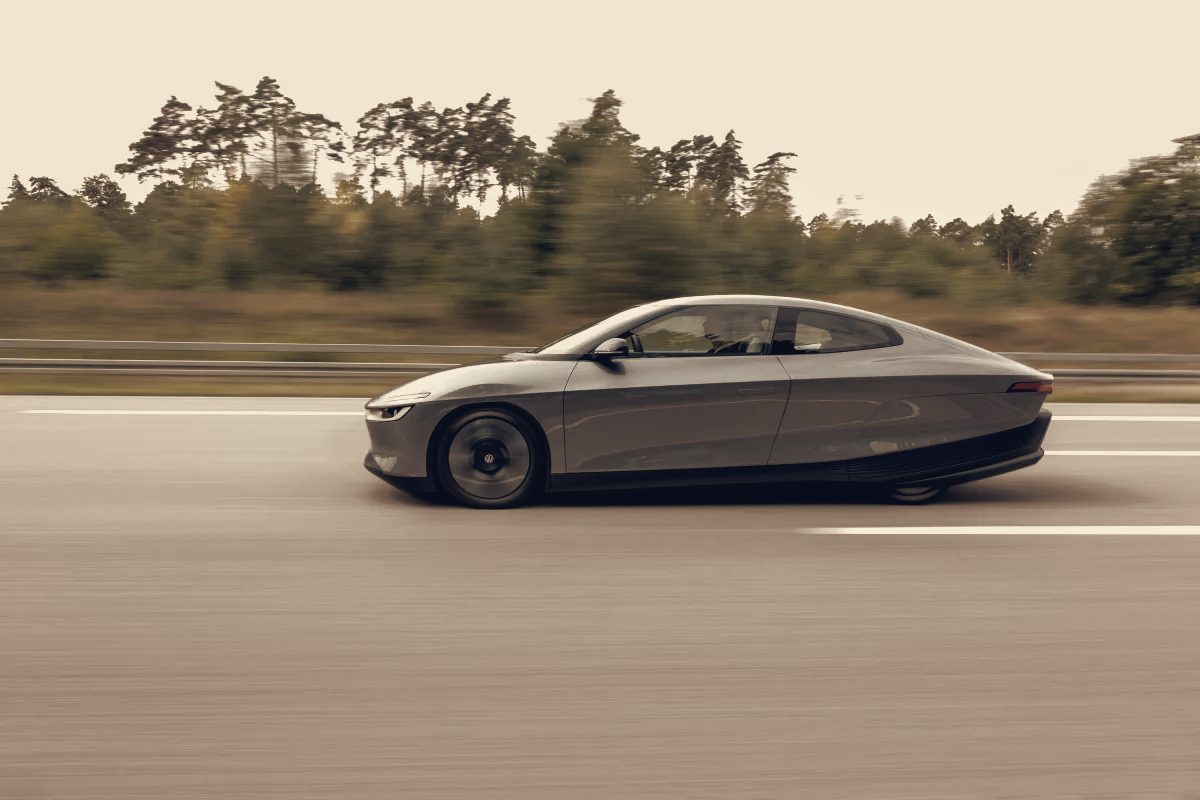
Drivers and automakers could extract far more range from much smaller batteries after Volkswagen drove its Mission Efficiency prototype 794 miles on a single charge, consuming 7.51 kilowatt-hours per 100 miles and arriving with 104 miles of range left. The company says the concept can hit the equivalent of 323 miles per gallon under ideal conditions, a performance that makes it almost twice as efficient as the most efficient production car, the Lucid Air Pure.
Volkswagen built the teardrop-shaped Mission Efficiency using the electric motor and battery from the ID. Polo, elements the company describes as bringing the vehicle to a near production state. On the Wolfsburg-to-Vienna run engineers charged once and logged an average consumption that equates to roughly 279 MPGe, a real-world demonstration that underlined the prototype's focus on uncluttered efficiency rather than everyday practicality.
The car achieves its low energy use through extreme aerodynamics and minimized frontal area. Designers pushed the roofline into a Kammback profile and reduced the coefficient of drag to 0.158 while keeping the frontal area to 2.08 square meters. Those choices also produce compromises: the Mission Efficiency is a 2+2 layout and Volkswagen says the rear seats suit people shorter than 5-foot 3 inches, about 1.6 meters, and the tight clearance between wheel arches and tires may affect ride comfort.
Not all conventional equipment survived the efficiency drive. Volkswagen retained physical side mirrors rather than switching to cameras for depth perception, and added solar cells on the roof and trunk lid that can contribute about 18 miles on perfectly flat, sunny routes driven at a steady 42.25 mph. Inside, the design strips out a built-in infotainment system, echoing a move by startup Slate Auto: the prototype offers a portable Bluetooth speaker and assumes occupants will use their own devices.
By back-of-the-envelope math VW’s experiment could yield more than 400 miles of range from a 54.9-kilowatt-hour battery, though the company did not present an EPA rating and stopped short of promising production. Volkswagen highlights a precedent: it produced 250 examples of the efficiency-focused XL1 more than a decade ago, with prices from €110,000 in 2013, showing the firm has converted halo concepts into limited runs before. For now Mission Efficiency demonstrates how far packaging and aero alone can push EV economy, and whether Volkswagen will move this near-production experiment into the market remains undecided.