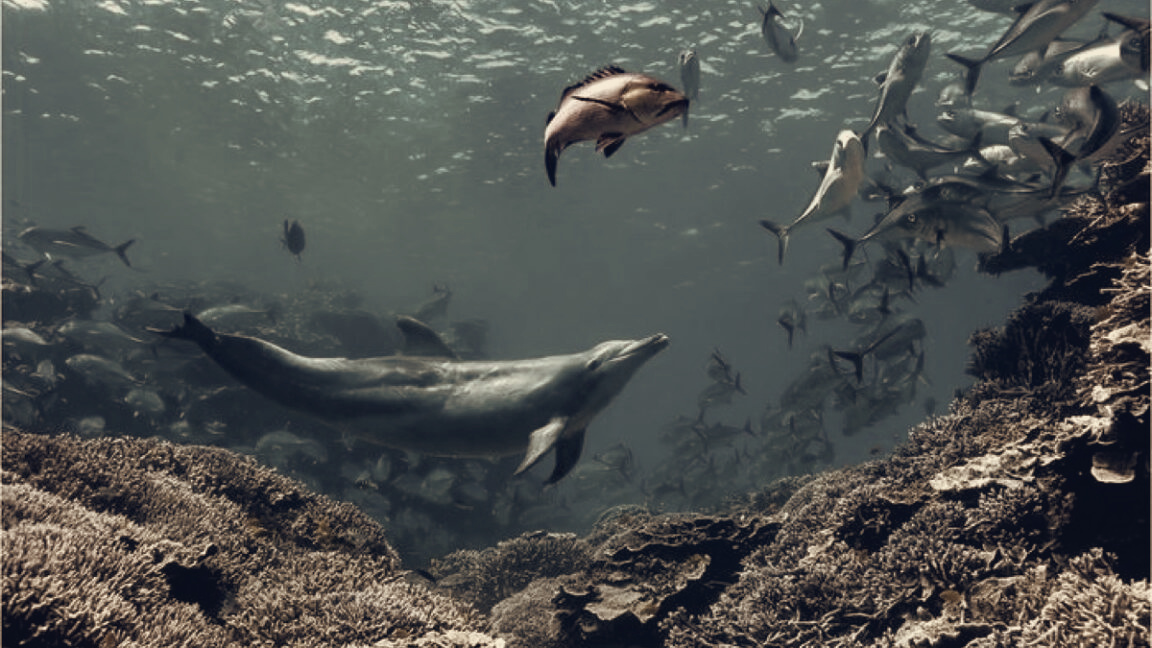
A male bottlenose dolphin known locally as Bubbles has been observed provoking large prey fish until they disgorge their recent catches, then eating the expelled food. That behaviour hands the dolphin an obvious advantage, while the targeted bigeye trevally lose both the prey item and the energy spent fleeing. The pattern is described in a study published in Ecology and Evolution and is based on sustained field observations at Lady Elliott Island, off Australia’s southern Great Barrier Reef.
Researchers say the interactions have been recorded repeatedly since at least 2017. Resort staff at Lady Elliott Island supplied the long-term sightings that underpin the paper’s account, allowing the authors to document a consistent sequence: Bubbles singles out bigeye trevally, pursues and stresses the fish, then consumes what the trevally expel.
The team classifies the tactic as kleptoparasitism, the appropriation of food obtained by another animal. The paper places the behaviour alongside a wide range of theft strategies documented across the animal kingdom, from parasitic wasps that exploit other insects to mammals such as bears, coyotes, wolves, hyenas and jackals, and seabirds including gulls, terns, bald eagles, skuas and frigatebirds. The authors note that kleptoparasitism often appears opportunistic and crosses diverse taxonomic groups.
Co-author Asia Haines of the University of the Sunshine Coast warned against sentimental views of dolphins, arguing, "This perception of dolphins as the ‘good guys of the sea’ has more to do with anthropomorphism, our tendency to assign human characteristics to them, and perhaps that’s because dolphins appear to be smiling. Dolphins are predators and actively hunt their prey, whether it has been stolen from another species or not."
By supplying a detailed, multi-year record of repeated interactions between a single dolphin and a fish species, the study adds a marine case study to the catalogue of kleptoparasitic tactics. The authors use that record to challenge anthropomorphic assumptions about dolphin behaviour and to underline that food theft and aggressive acquisition are widespread ecological strategies.