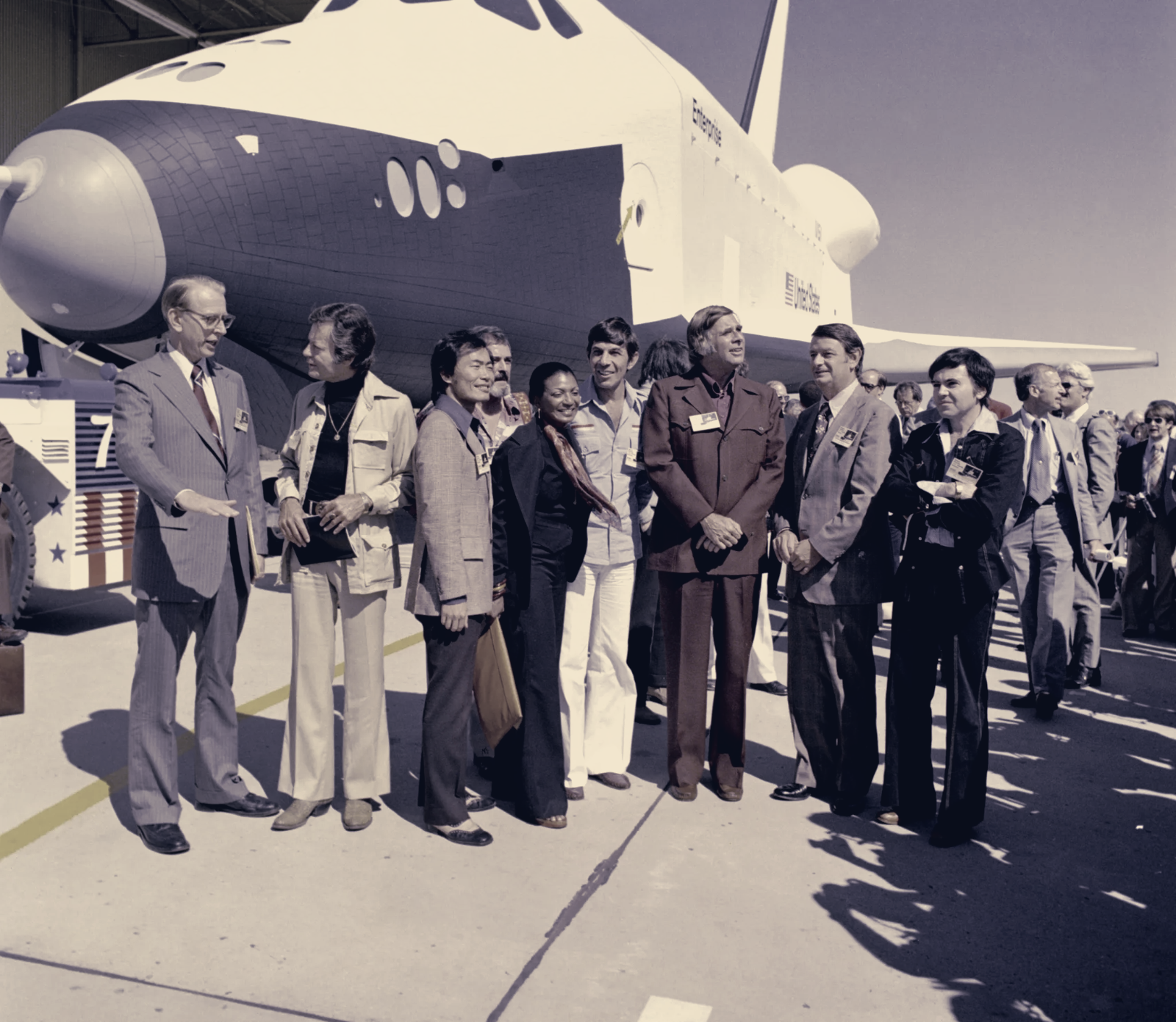
The public debut of OV-101 handed NASA a test vehicle for atmospheric evaluation that directly enabled the space shuttle program’s first orbital flights in 1981. The orbiter, christened Enterprise, was revealed at a rollout ceremony on Sept. 17, 1976, Constitution Day in America’s bicentennial year.
NASA had planned to call the vehicle Constitution, but a broad public campaign shifted that decision. Nearly 100,000 Star Trek fans wrote the White House asking that the orbiter carry the name of the fictional starship USS Enterprise. In a memo President Gerald Ford ordered NASA to use the name, saying he was "partial to the name." The choice also echoed a long U.S. naval tradition, the name having been used for an early American Revolutionary War vessel, a World War II carrier, and the Navy’s first nuclear-powered carrier.
The unveiling took place at Rockwell’s Palmdale facility in southern California, with hundreds of invited guests on hand. The rollout included Star Trek creator Gene Roddenberry and several principal cast members, alongside NASA leadership and congressional representatives.
Although OV-101 was not outfitted for orbital missions, the vehicle performed critical atmospheric test flights that validated approach, handling and landing profiles for the shuttle design. Those tests were an essential step toward the program’s transition from atmospheric flight trials to operational space missions beginning in 1981. Enterprise itself never flew in space and today is exhibited at the Intrepid Museum in New York City.
The event illustrates how public engagement, political direction and industrial work combined during the shuttle’s development, producing a testbed that reduced technical risk before the program’s first crewed launches. Enterprise’s rollout remains a visible moment in NASA’s shuttle era and in the crossover between popular culture and aerospace history.